
 Established 2016
Cut a small wedge out of your lawn with a spade and look at it from the side. Three distinct layers: green leaf at the top, dark soil at the bottom, and between them a band of brown fibrous material that looks a bit like coconut matting. That middle layer is thatch, and how thick it is tells you more about the health of your lawn than almost anything you can see from standing height.
🎧 Prefer to listen? Get the full guide in your ears
What Is Lawn Thatch and Why Does It Matter?
Thatch sits behind a surprising number of lawn problems that get blamed on something else. Drought damage, patchy fertiliser response, recurring moss, disease that keeps coming back to the same spots. Knowing what it is and where it comes from makes all of those easier to solve.
What Lawn Thatch Is Made Of
Thatch is a layer of dead and decaying organic matter that accumulates on the soil surface, underneath the living grass. Specifically: grass stems, crowns, rhizomes, stolons and old roots, along with dead moss and whatever other plant debris has ended up in the sward.
What these materials have in common is lignin, the tough structural compound that gives plant stems their rigidity. Lignin is difficult for soil organisms to break down, which is precisely why this material accumulates while softer plant tissue disappears within weeks.
A thatch layer is not inherently a fault, though. A thin one is useful. It cushions the surface against foot traffic, insulates the crowns against temperature swings, and holds a little moisture at the surface. Lawns with no thatch at all tend to be more vulnerable to wear rather than less.
Grass Clippings Are Not Thatch
This is the most persistent misunderstanding in lawn care, and correcting it changes how people mow.
Grass clippings are roughly eighty per cent water and contain very little lignin. Left on the lawn they break down within a couple of weeks, returning nitrogen and organic matter to the soil. They do not become thatch, and mulch mowing does not cause a thatch problem.
If anything the reverse is true. Returning clippings feeds the soil bacteria that decompose organic matter, and a more active soil population breaks thatch down faster. Lawns that are mulch mown and well fed frequently carry less thatch than lawns where every clipping is collected.
The confusion comes from the fact that a lawn with a genuine thatch problem often does have clippings sitting visibly on the surface, because the dense layer stops them settling down to the soil where decomposition happens. The clippings are a symptom of the thatch, not its cause.
The Equation That Governs Everything
Thatch accumulation is a balance. On one side, organic matter is being produced by the grass as it grows, sheds old tissue and replaces roots. On the other, soil organisms are breaking that material down.
While decomposition keeps pace with production, the layer stays thin and stable and you never think about it. When production outpaces decomposition, the layer thickens.
Everything that causes a thatch problem either increases production or suppresses decomposition. That framing explains why thatch is rarely a problem on its own. Compacted soil, low microbial activity, high salt fertilisers, acidic soil and heavy shade all slow decomposition. Excessive nitrogen and aggressive growth increase production. A lawn with a thatch problem almost always has one of those driving it.
How Much Is Too Much
Take the wedge sample described at the top of this article, from two or three different areas, and measure the brown fibrous band with a ruler.
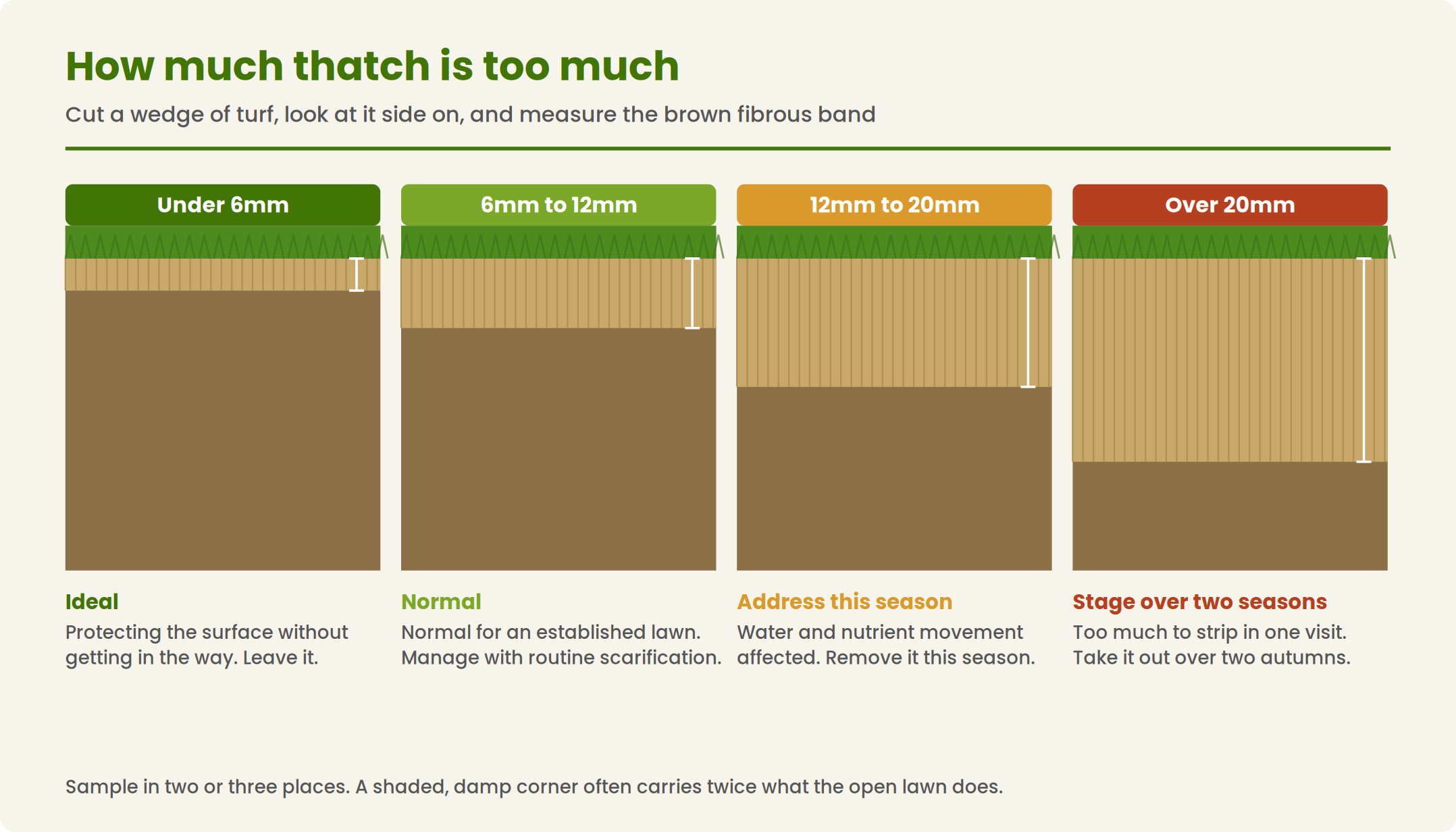
- Under 6mm. Ideal. The layer is doing its protective job without interfering with anything.
- 6mm to 12mm. Normal for an established lawn. Worth managing with routine scarification, not a cause for concern.
- 12mm to 20mm. Beginning to cause real problems with water and nutrient movement. Needs addressing this season.
- Over 20mm. Significant. Removal needs staging across two seasons rather than attempting it in one visit.
Sample in more than one place. The shaded, damp corner of a lawn will often carry twice the thatch of the open, sunny section, and an average across the whole lawn hides that.
What Goes Wrong When It Builds Up
Water stops getting through
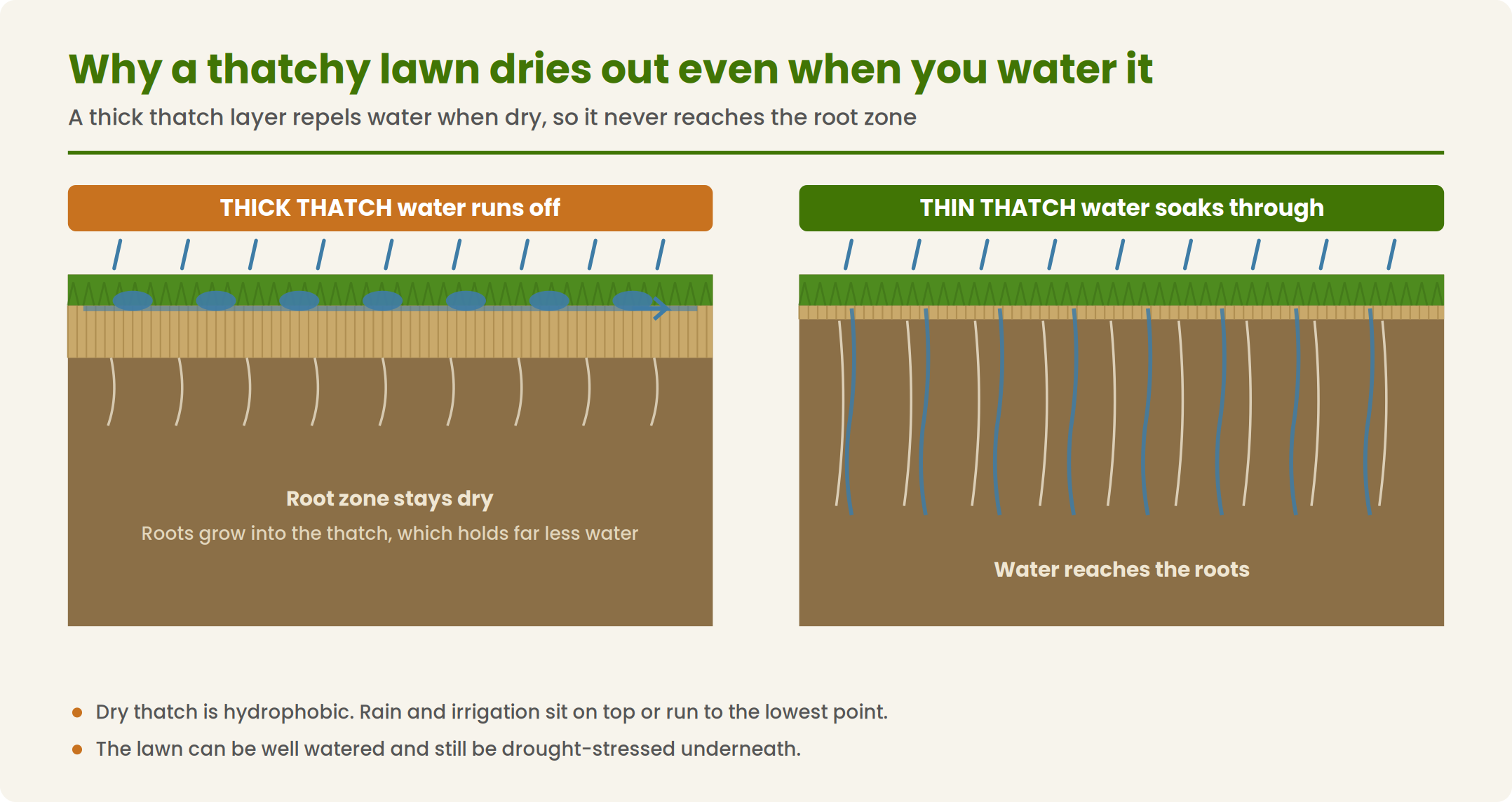
A thick thatch layer is hydrophobic when dry, meaning it actively repels water. Rain and irrigation run across the surface or sit on top rather than soaking down to the root zone. The lawn can be receiving plenty of water and still be drought-stressed underneath.
Fertiliser stops working
Nutrients applied to the surface lodge in the thatch and never reach the soil where roots can access them. This is a common reason people conclude their feed is not working and apply more of it, which compounds the problem by encouraging growth without addressing the barrier.
Roots grow in the wrong place
The most damaging consequence. When thatch is thick and moist, grass roots start growing into the thatch layer rather than into the soil below it. Thatch holds far less water than soil and dries out much faster, so a lawn rooted into thatch becomes drought-vulnerable in a way that is difficult to reverse without removing the layer.
Disease finds ideal conditions
Thatch holds moisture against the base of the grass plant and restricts air movement through the sward. Those are close to ideal conditions for fungal pathogens, which is why red thread and fusarium tend to recur in the same areas year after year on thatchy lawns.
Pests move in
Chafer grubs and leatherjackets favour thatchy lawns, and a thick organic layer gives them both shelter and food. Secondary damage from birds, badgers and foxes digging for those grubs is often far worse than the damage the grubs do directly.
The pattern worth noticing is that none of these problems announce themselves as thatch. They present as drought damage, poor feed response, recurring disease, or animal damage. It is why thatch so often gets treated as five separate problems rather than one.
Why Some Lawns Build It Faster Than Others
Two lawns on the same street, mown the same way, can carry very different thatch depths. The variables are mostly below the surface.
- Soil type. Heavy clay holds less air and supports lower microbial populations than light sandy soil, so decomposition is slower and thatch accumulates faster.
- Compaction. Squeezing air out of soil suppresses the aerobic organisms doing the decomposing. It is why aeration slows thatch accumulation even though it removes none of it.
- Fertiliser type. High salt index synthetic fertilisers suppress soil bacteria. Feeding the grass hard while damaging the organisms meant to process the resulting growth is a reliable way to build thatch quickly.
- Soil pH. Microbial activity drops off in acidic soil. A lawn sitting at pH 5.5 decomposes organic matter considerably more slowly than one at 6.5.
- Grass species. Creeping species that spread by stolons and rhizomes, including bentgrasses and some fescues, produce more of the lignin-rich tissue that becomes thatch than tufted ryegrasses do.
- Shade and moisture. Cool, damp, low-light areas have slower biological activity and often carry dead moss on top of everything else.
Managing It Without Removing It
Since thatch is a balance between production and decomposition, the sustainable approach is to support the decomposition side rather than relying entirely on annual removal.
Aerating restores air movement and revives the microbial populations doing the work. Mulch mowing returns easily digestible material that feeds those populations. Feeding with a plant-based, low salt index product supports soil biology rather than suppressing it. Correcting acidic pH, where a soil test shows it is needed, brings microbial activity back up. Top dressing works fine soil particles into the thatch layer, which encourages decomposition by putting soil organisms in direct contact with the material.
None of these remove existing thatch. What they do is slow the rate at which it rebuilds, which over several years is the difference between scarifying annually and scarifying every third year.
When Removal Becomes Necessary
Once the layer is past roughly twelve millimetres, biological management alone will not bring it back down in any reasonable timeframe. At that point it needs to come out mechanically, which means scarification.
The practical rule is that thatch above twenty millimetres should not be removed in a single visit. Taking that much material out at once removes so much grass cover that the lawn cannot close back over before winter, leaving open ground for weed seeds and moss spores. Staging it across two autumns, with overseeding and feeding each time, produces a far better result.
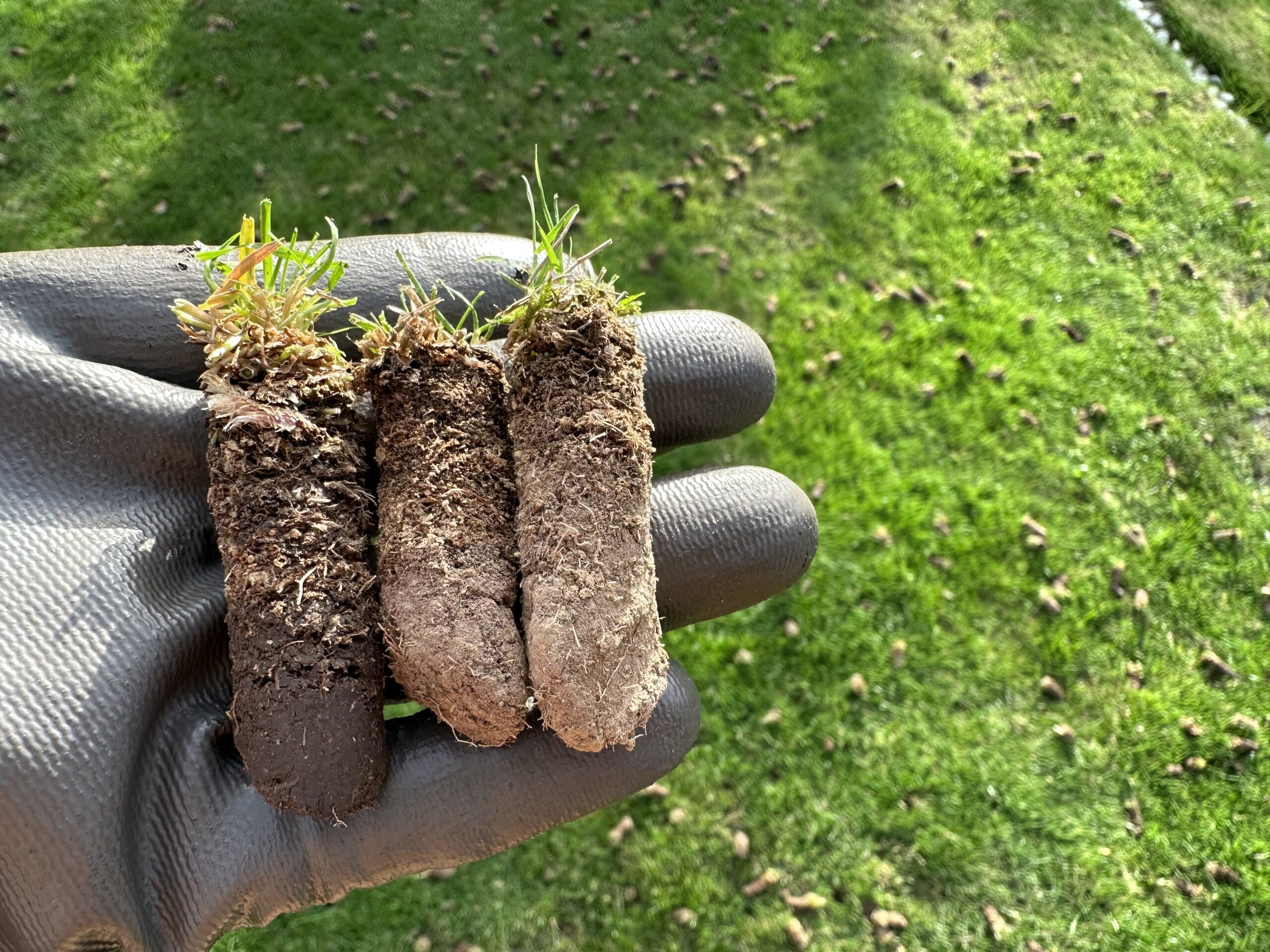
It is also worth pairing removal with aeration in the same visit, and the order matters. We aerate first, then scarify. Aerating an intact surface gets the tines to full depth, and the scarification pass that follows lifts the thatch and breaks up the cores together, so you finish with one clean surface rather than a separate collection job. There is a second benefit below ground: as the cores break down, some of that organic material drops into the open holes, which puts a food source down at root depth for the soil biology instead of leaving it at the surface where it would simply become more thatch.
Scarifying alone treats the accumulated material while leaving the compaction that caused the slow decomposition in the first place, so the layer simply rebuilds at the same rate.
How We Assess It
We take a thatch measurement on the first visit to any lawn, from several points rather than one, and that reading determines what we recommend. A lawn at 5mm gets left alone. A lawn at 15mm gets scarified. A lawn at 25mm gets a two-year plan.
We also use a plant-based, low salt index fertiliser as standard, partly because it feeds soil biology rather than suppressing it, which directly slows the rate at which thatch rebuilds between treatments.
We have been established since 2016, we cover Hampshire, Surrey, West Sussex and Berkshire, and our technicians are City and Guilds qualified. We hold BASIS Lawn Assured accreditation, work to the Amenity Standard, and are members of the UK Lawn Care Association.
Frequently Asked Questions
A layer of dead and decaying plant material sitting between the living grass and the soil, made up of old stems, crowns, roots, rhizomes and stolons, along with dead moss. What holds it together is lignin, which soil organisms find hard to break down. Soft green tissue rots away in weeks. Lignin-rich tissue accumulates, and that accumulation is thatch.
No, and this is worth knowing because it changes how you mow. Clippings are around eighty per cent water with very little lignin in them, and they break down within a fortnight. Returning them actually feeds the bacteria that decompose thatch, so mulch mown lawns often carry less of it. If you can see clippings sitting on the surface, that is the thatch layer stopping them reaching the soil, which is a symptom rather than a cause.
Cut a wedge of turf out with a spade, around seventy five millimetres deep, and look at it side on. You will see green leaf, then a brown fibrous band, then soil. Measure the brown band with a ruler. Do it in two or three places, because a shaded damp corner often carries twice what the open lawn does and an average across the whole lawn hides the worst of it.
No. Under six millimetres it is doing useful work, cushioning the surface against foot traffic, insulating the crowns against temperature swings and holding a little moisture. Lawns with no thatch at all tend to wear more easily. The problem is quantity rather than existence, and the aim is to manage the layer rather than eliminate it.
Up to a point. Aeration, mulch mowing, a low salt index feed, correcting acidic pH and top dressing all support the organisms that decompose it, and together they slow accumulation considerably. What they cannot do is reduce a layer that is already thick. Past about twelve millimetres, biological management will not bring it down in any useful timeframe and it has to come out mechanically.
Aerated first. Working an intact surface lets the tines reach full depth, and the scarification pass that follows lifts the thatch and clears the cores in one go. It also means some of the organic material ends up down in the tine holes feeding soil biology at root depth, rather than sitting on the surface adding to the layer you have just removed.
Thatch is the usual answer. A thick layer is hydrophobic when dry, so water runs across it or sits on top rather than soaking through to the root zone. Worse, once the layer is thick and moist the grass starts rooting into it rather than into soil, and thatch holds far less water than soil does. The lawn is then drawing on a shallow band of material that dries out first, which is why it browns off while the neighbours stay green.
Not sure how much thatch your lawn is carrying?
We measure it properly, from several points across the lawn, and tell you what the reading actually means. Sometimes that means recommending a treatment. Sometimes it means telling you your lawn is fine and to leave it alone this year.







 Made with love by: