

 Established 2016
Overseeding sounds simple enough. Scatter seed over the existing grass, wait, and let it fill in. In practice the results vary enormously. One homeowner overseeds in autumn and is delighted with the lawn by the following spring. Another does the same job, with seed from the same bag, and almost nothing comes up. The seed is hardly ever the reason.
🎧 Prefer to listen? Get the full guide in your ears
Is Overseeding Worth It? What UK Homeowners Need to Know
So is it worth doing? Yes, provided it is done properly and at the right time of year. On a thin, patchy or ageing lawn there are few things that give you more for your money. It brings in younger, more vigorous plants, closes the gaps that weeds and moss would otherwise take, and lets you introduce better grass varieties, denser, more disease-resistant, or simply better suited to your garden. Set against re-turfing, which is the usual alternative once a lawn has really gone downhill, the cost difference is substantial.
Getting a good result reliably comes down to three things: knowing what overseeding can and cannot fix, giving it the conditions it needs, and preparing the surface properly. That last one is where most disappointing jobs go wrong.
What Overseeding Actually Does
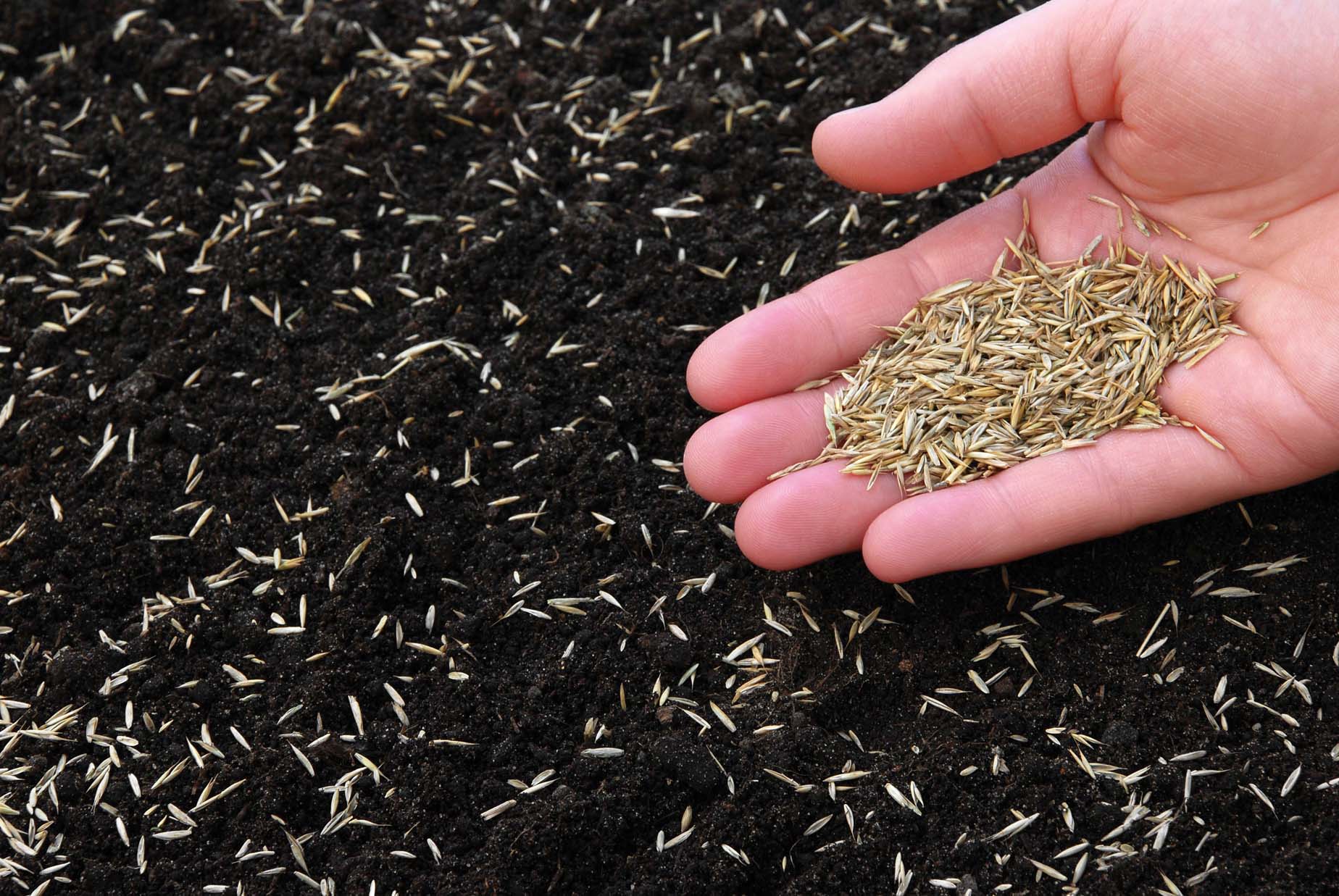
Overseeding means broadcasting grass seed over a lawn you are keeping. It is not full re-seeding, where the existing surface is stripped off first, and it is not re-turfing, where the surface is replaced with grown turf.
The aim is to thicken the lawn and improve what it is made of. Every lawn loses grass plants over time, even a well-kept one. Wear, seasonal stress, disease and simple old age all take their toll, and if nothing new goes in, the sward thins and the gaps between plants widen. Moss, weeds and annual meadow grass are quick to move into those gaps. Overseeding runs that process backwards, putting young plants in alongside the established ones so the lawn gets denser rather than thinner.
When Overseeding Works Well
The right time of year
There are two windows in the UK. The main one runs from mid-August through to the start of November, and September and October are the pick of it. The soil is still warm from summer, so seed germinates quickly. Air temperatures are coming down, so seedlings are under less evaporation stress. Rainfall is picking up, which cuts the amount of watering you have to do. And anything sown in that period has enough growing weather to build a root system before the cold arrives.
The window is longer than a lot of published advice suggests. In the south of England soil temperatures hold up well into the autumn, and we continue overseeding as part of renovation work to the start of November. Germination slows as the season goes on and the seedlings have less time in hand, so earlier in the window is steadier, but sowing in late October is a great deal better than waiting five months for spring.
Spring, from mid-March to May, is the second window. It works, but the run-up to summer is shorter, so the seedlings have less time to establish before the heat. For patching a few specific areas, or for a lawn where autumn came and went entirely, spring is fine. For a serious overseeding job, autumn is the better bet.
Adequate soil preparation
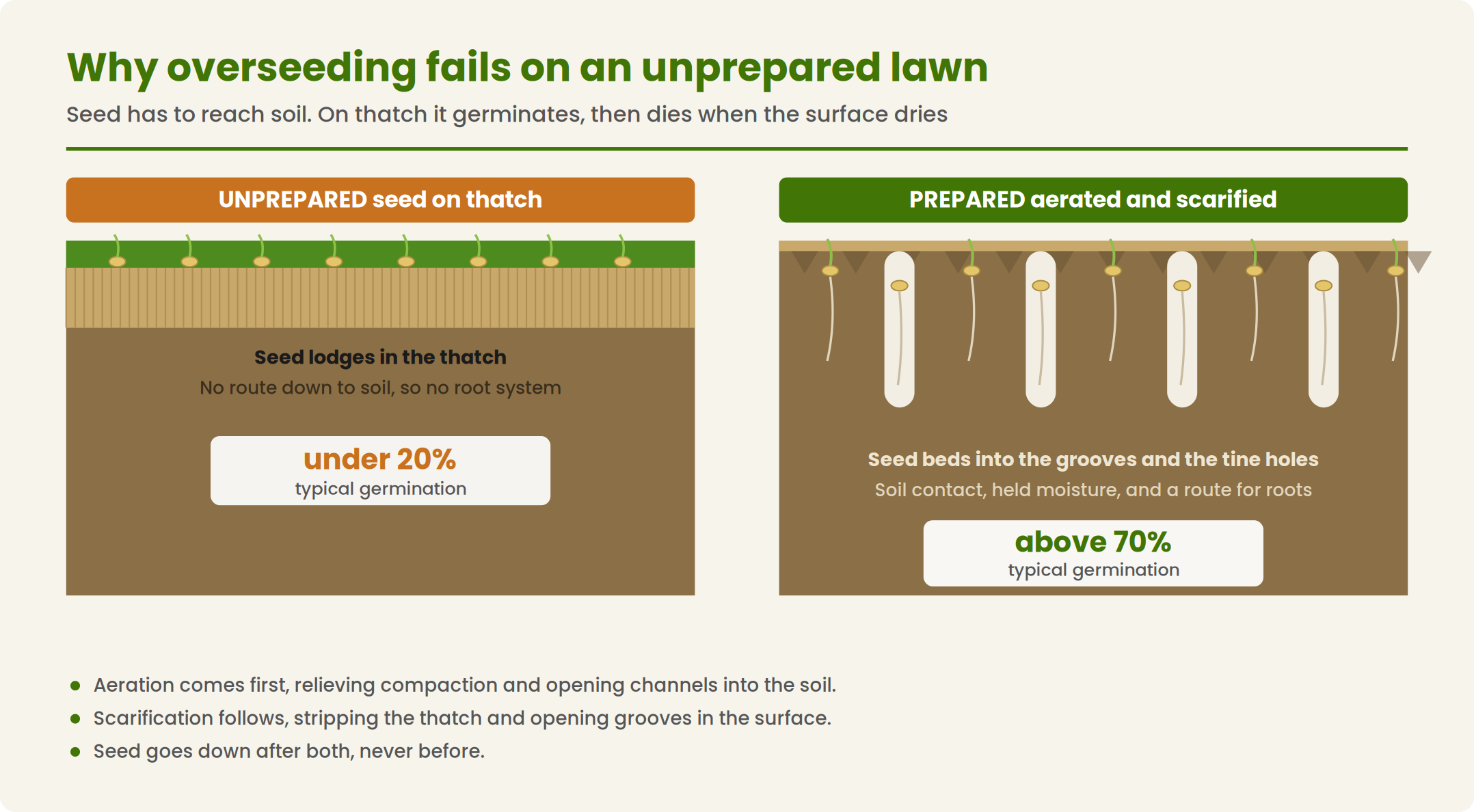
More overseeding fails for this reason than any other. Seed needs to touch soil to germinate and root. Broadcast onto a thick layer of thatch, it sits on top of the organic material, never reaches the soil, and germination is patchy at best. Even the seed that does sprout in the thatch has no route down to the mineral soil, so it cannot build the roots it needs.
The surface has to be prepared, and the order matters. Aeration comes first, relieving compaction and opening the soil. Scarifying then strips out the thatch and opens up channels in the surface. Between them they give you a seedbed rather than a green carpet, and where hollow tines have been used the holes themselves become pockets where seed sits in excellent contact with soil and holds moisture well. On a lawn carrying real thatch this preparation is not optional. It decides whether the seed comes up at all.
Which type of aeration suits a given lawn depends on the ground. Hollow tines remove cores and are the right choice where compaction is significant or the lawn has never been aerated properly. Solid tines and slitting suit lighter soils and lawns already in reasonable condition. That call comes from assessing the lawn rather than applying a rule.
The right seed for the conditions
Grass seed is not one product. Varieties differ enormously in wear tolerance, shade tolerance, drought tolerance, leaf texture, disease resistance and how quickly they germinate. Pick the wrong mix for your lawn and establishment will be poor no matter how well you do everything else.
A lawn that takes regular traffic from children and dogs wants a hard-wearing mix dominated by perennial ryegrass, which comes up fast, takes a beating and recovers. A finer ornamental lawn does better with a higher proportion of fescues, which give a finer leaf and a denser sward. A shaded lawn, or the ground under a tree canopy, needs a shade-tolerant mix with creeping red fescue and wood meadow grass, which will establish in light levels where standard mixes simply will not.
When Overseeding Does Not Work
Without adequate preparation
Thick thatch gives poor germination. A compacted surface sheds water rather than absorbing it, which leaves new seedlings exposed to drying out before they have rooted. The wrong season will cost you too, high summer especially, when the soil is hot and moisture is short, which produces patchy germination and heavy seedling losses. And the wrong seed mix will let you down even when everything else has been done properly.
In areas with structural problems
Some parts of a lawn resist grass for structural reasons rather than management ones. Mature tree roots compete hard for water and nutrients, and directly under a canopy grass often will not hold at all. Ground that waterlogs persistently will not support healthy grass however many times you seed it.
Overseeding these areas again and again without dealing with the underlying cause simply repeats the disappointment. Working out whether the problem can be managed, with a shade-tolerant mix, better drainage or aeration, or whether something different is needed altogether, saves a good deal of time and money.
When the existing grass is too sparse
Overseeding works by adding to what is already there. Where coverage has dropped below about thirty to forty per cent, with the rest moss, weeds or bare ground, seeding into it will not achieve much. Aeration and a full scarification to take the moss out and clear the surface, then seed onto a properly prepared seedbed, will give you a far better result than seed scattered over a thin, mossy lawn.
How to Overseed Successfully: The Practical Steps
Prepare the surface
Mow slightly shorter than usual first, which gets more light down to the soil and reduces competition from the existing grass. Aerate to relieve compaction and open the soil. Scarify to take out the thatch and open up the surface. If you are overseeding without a full renovation, even a hard raking with a spring-tine rake to rough up the surface will noticeably improve germination compared with seed dropped onto undisturbed ground.
Apply the seed
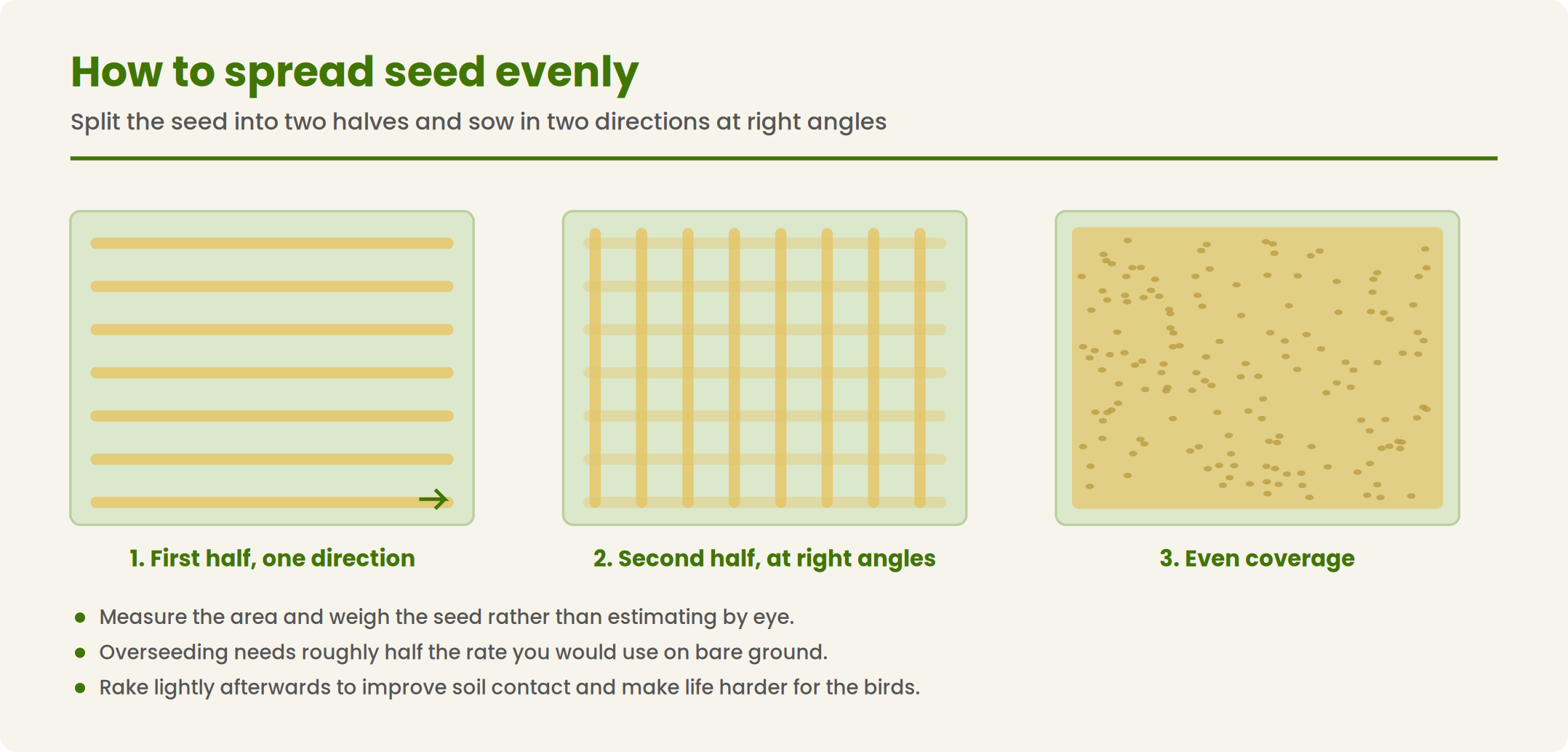
Work out the seeding rate from the packet for the area you are covering. To get it even, split the seed into two equal lots. Broadcast the first walking in one direction, then the second at right angles to it. That cross-hatch gives much better coverage than a single pass one way. Rake it in lightly afterwards to improve soil contact and to make life harder for the birds.
Maintain moisture during establishment
This is the job that matters most once the seed is down. Seedlings cannot survive drying out before their roots are established. In September and October conditions the rain usually does enough on its own, but through a dry spell you will need to water, gently, and often enough to keep the surface moist without washing the seed about or leaving the ground standing wet.
Most varieties germinate within seven to fourteen days at September soil temperatures, and rather longer as the soil cools through October and into November. Once the seedlings are clearly up you can ease off and let the rain take over. They will need roughly four to six weeks to build enough root depth to cope on their own.
First cut and ongoing management
Let the new grass reach five to six centimetres before you cut it. Keep the mower high for the first two or three cuts so you are not taking off much of the new growth, then bring the height down gradually as the grass establishes and the roots deepen. Keep heavy traffic off newly seeded areas until the grass is properly established, which usually means six to eight weeks after germination. On a late sowing that will mean leaving it alone over winter and letting it come away properly in spring.
Overseeding Versus Re-turfing: When Each Is the Right Choice
For most lawns that need improving, overseeding is the answer. It costs less, works with the lawn you already have, gives excellent results when done properly, and avoids the disruption and establishment demands that come with new turf.
Re-turfing earns its place in a few specific cases. Where viable grass coverage has fallen below roughly thirty to forty per cent and the rest is weeds, moss or bare soil, turf laid onto a properly prepared bed will reach an acceptable finish faster. Where the soil itself needs serious remedial work, or where the lawn has to be usable within weeks rather than months, turf has a practical edge.
Far more often, though, a tired or patchy lawn gets treated as a re-turfing job when aeration, scarification and overseeding would have produced the same result, or a better one, for a fraction of the cost and upheaval.
Why Professional Overseeding Produces Better Results
There is a real difference between a professional overseeding job and a homeowner emptying a bag of seed onto the lawn. Seed selection is matched to the grasses already growing there, to how the garden is used, to the shade and drainage in different parts of it, and to what the customer wants the finished lawn to look like.
Professional scarifiers and aerators go deeper and take out more material than hire or domestic machines usually manage, which leaves a better seedbed. Application rates are calculated for the actual area and existing coverage rather than guessed at. And the order and timing of each step come from having done the job a great many times.
At Shrekfeet, overseeding forms part of a full autumn renovation programme that deals with why the lawn thinned in the first place, rather than simply adding seed to an unchanged surface. We continue that work into November, so a lawn that has been left late in the season is often still worth treating this year. We have been established since 2016. Our City and Guilds trained technicians assess each lawn before the programme is designed. We hold BASIS Lawn Assured accreditation, work to the Amenity Standard, and are members of the UK Lawn Care Association, covering Hampshire, Surrey, West Sussex and Berkshire.
Frequently Asked Questions
Germination takes seven to fourteen days in September conditions and longer as the soil cools through October. The lawn starts to look noticeably fuller after four to six weeks as the seedlings thicken up. The full benefit shows the following spring, when the new plants come into their first proper growing season with an established root system.
Later than most guidance suggests. We overseed as part of renovation work to the start of November, and in the south of England soil temperatures hold up well enough for useful establishment. Germination is slower and the seedlings have less time in hand, so results are steadier earlier in the window, but a late October sowing beats waiting until March.
It is not advisable. Hot soil and scarce moisture give patchy germination and heavy seedling losses, and keeping a seeded area moist through a July dry spell takes constant watering that most people cannot sustain. Wait until the middle of August, when soil temperatures are still high but the weather is turning in your favour.
Aerate first, then scarify. Relieving compaction before the surface is stripped gives the better seedbed, and it avoids working loose surface debris down into freshly opened channels. Where hollow tines have been used, the holes make excellent seed pockets. Seed goes down after both, and feeding follows the seed.
Follow the rate printed on the packet for the mix you are using, because rates vary between varieties. Overseeding needs roughly half what you would use to establish a lawn from scratch, since you are supplementing existing grass rather than starting over. Measure the area rather than estimating it, and resist the urge to add extra. Overcrowded seedlings compete with each other and the result is weaker, not thicker.
Some of it, yes, though the losses are usually smaller than people fear. Raking the seed lightly into the surface makes a considerable difference, because seed sitting exposed on top is far easier to find. A light top dressing over the seeded area helps as well. For a small patch, netting for the first ten days or so is straightforward enough.
Keep off it as much as you reasonably can until the new grass is established, which is generally six to eight weeks after germination. Crossing it occasionally will not undo the work, but regular traffic on seedlings that have not yet rooted properly will thin out exactly the areas you were trying to fill.
Yes, and an autumn formulation is the one to use. Apply it after the seed is down rather than before. The phosphorus supports both the new seedlings and the roots of the existing grass. Avoid a high-nitrogen spring feed, which pushes soft growth at the wrong time of year, and leave selective weedkillers alone for six to eight weeks, because they damage young grass.
Ready to thicken up your lawn this autumn?
Our technicians cover Hampshire, Surrey, West Sussex and Berkshire. We will assess your lawn, design the right programme, and overseed at the right time with the right seed for your specific conditions.




 Made with love by:
