

 Established 2016
January is the month most lawns look their worst and most owners feel they should be doing something about it. Flat, dull, soft underfoot, mossy in the shaded corners, and marked with every footprint made since Christmas.
The useful answer is not a long list of jobs. It is a short list of things worth doing, a slightly longer list of things that will cause damage, and a clear sense of which problems can simply wait.
🎧 Prefer to listen? Get the full guide in your ears
January Lawn Care: What to Do, What to Avoid and What Can Wait
What Is Actually Happening to the Lawn
Two things, and understanding both explains everything else.
The grass is dormant. Soil temperature is too low for meaningful root activity, so the lawn is holding position rather than growing. It is not repairing damage, not filling gaps and not responding to anything you give it. Whatever condition it was in when growth stopped is the condition it stays in until spring.
Moss is not dormant. It tolerates low light, low temperatures and damp still conditions perfectly well, so while the grass is doing nothing the moss is still working. Any gap in the sward at the point growth stopped is an opening it will take over the following months.
So January is not a month where a lawn improves. It is a month where it either holds steady or loses ground, and most of what you can do is about which of those happens.
Worth Doing in January
Keep off it when frozen or saturated
The single most valuable thing on this list, and it costs nothing.
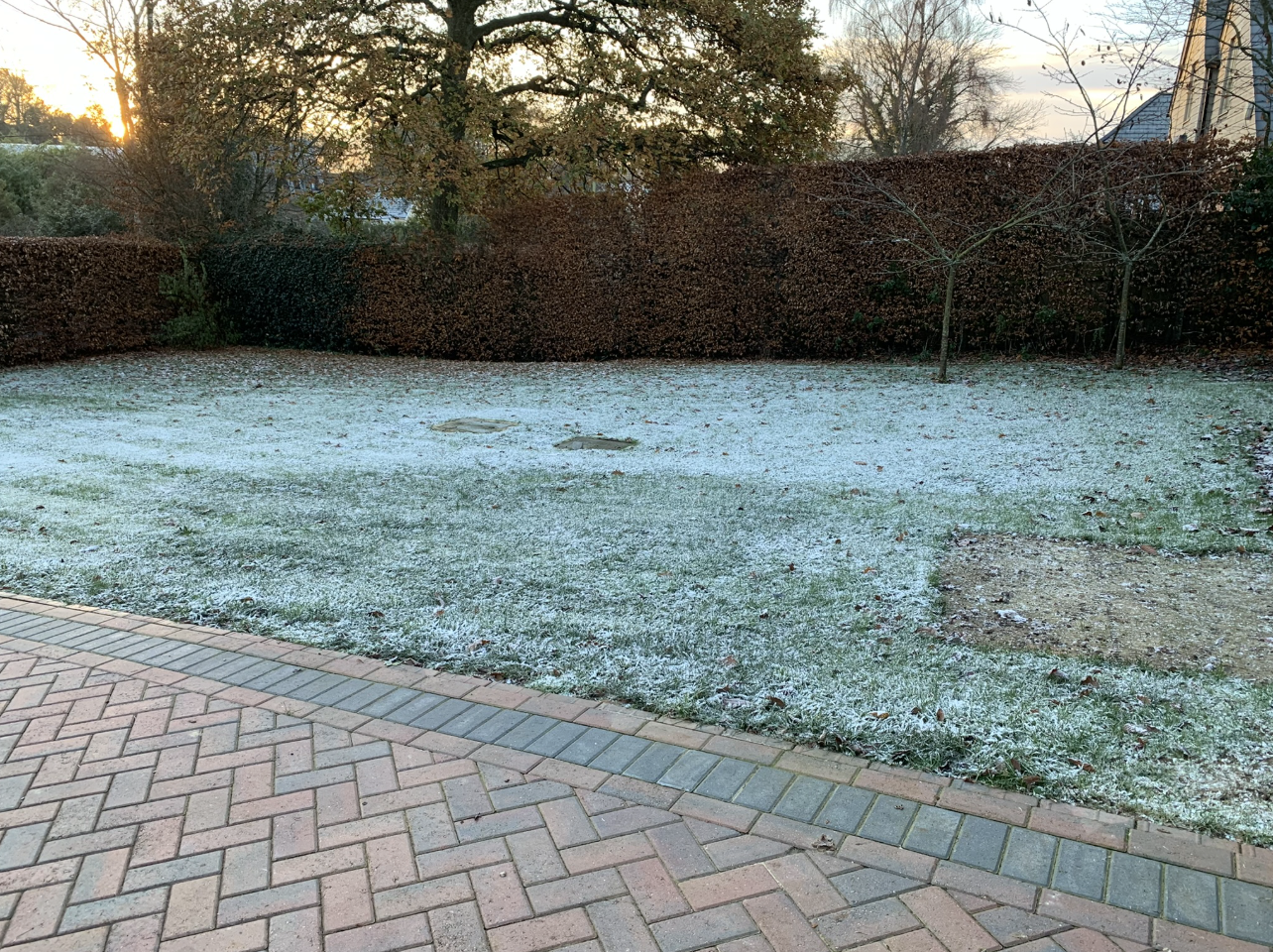
Frozen grass blades are rigid and brittle. Walking across them crushes the cells and ruptures the cell walls, and because the lawn is not growing it cannot replace the damaged leaf. The marks appear days later as dark patches and then as straw-coloured footprints, and they stay visible for weeks.
Saturated ground is a different problem with the same answer. Foot traffic on wet soil squeezes the air out and smears the structure, which makes drainage worse and shows up the following summer as compaction.
If a route across the lawn is unavoidable, stepping stones or a temporary path of bark or gravel boards takes the pressure off. It sounds trivial and across a winter it makes a considerable difference.
Clear leaves and debris
Still worth doing into January if any remain. A layer of wet leaf blocks light from grass that is already short of it, holds moisture against the crowns, and creates exactly the still damp conditions fungal disease wants.
Toys, furniture, trampolines and anything else left standing on the lawn should come off too. Anything that sits in one place through winter leaves a dead patch underneath it by March.
Brush off worm casts once they are dry
Casts appear through the mild damp months and they are a sign of healthy soil rather than a problem. The issue is only what happens when they are trodden on or mown while wet, since a smeared cast becomes a flat patch of bare soil sitting on the sward.
Let them dry, then brush or drag the surface on a dry day. A dried cast crumbles to nothing and the soil goes back into the lawn where it is useful.
Service the mower and sharpen the blades
This is the job more people should do and almost nobody does. The mower is not being used, the repair shops are quiet, and a blunt blade tears the leaf rather than cutting it. Torn tips brown off and give disease an entry point, so sharp blades matter more than most people assume.
Edging tools benefit from the same attention while you are at it.
Note where the water sits
Walk the lawn after heavy rain and note where water pools and how long it takes to clear. That information is far easier to gather in January than in June, and it tells you exactly where aeration and drainage work need to focus later in the year.
Do the same with moss. Where it is worst tells you where the shade, drainage or compaction problems are.
Not Worth Doing, and Some of It Harmful
Do not apply a nitrogen feed
This is where a lot of January advice goes wrong, and the market genuinely contradicts itself on it.
Nitrogen produces soft, lush growth. In January that tissue is thin-walled and has no time to harden, and it is precisely what fusarium patch wants. Fusarium is one of the few lawn diseases that attacks the crown as well as the leaf, so an outbreak leaves bare ground rather than discoloured grass. Nitrogen feeding should stop by November and the first feed of the year belongs in March as a controlled-release application.
A winter treatment is not the same thing as a feed, and the distinction matters. Our winter plan includes moss control, a lawn tonic providing the nutrients needed for cell production and repair, and a winter green-up that helps the lawn make use of low light levels. None of that is pushing growth. It is supporting a plant that is holding position. Advice telling you either to feed heavily in January or to do nothing at all is missing the middle.
Do not sow seed
Germination needs soil temperature above roughly eight degrees, and January is nowhere near that in a UK garden. Seed sown now mostly rots or washes out. Cold-tolerant mixtures exist and still want five degrees or more consistently, which January rarely provides.
Mark the bare patches and deal with them when conditions allow. The autumn window from late August to the start of November is the strongest, with spring from April as the second option.
Do not scarify or rake moss out
Moss treatment is a genuine winter job. Mechanical removal is not.
Raking or scarifying leaves bare soil sitting open through the wettest months, and the grass cannot grow into the gaps until spring, so you create exactly the openings moss recolonises. That work belongs in the window from the end of February to the start of May, or late August to the start of November.
Do not aerate frozen or saturated ground
Aeration is not locked to a season and can be carried out whenever conditions allow, which is a wider window than most people think. What matters is the state of the ground rather than the month.
Frozen ground will not take a tine. Saturated ground smears rather than fracturing, so the machine does more compacting than relieving. Between those extremes there are days in January when it is perfectly viable, which is why blanket advice either way is unhelpful.
Do not mow unless it has genuinely grown
In a mild spell the grass may put on a little growth, and a very light topping on a dry day does no harm. Do not go looking for a reason to mow, do not cut short, and never mow a frozen or sodden lawn.
Problems That Can Wait
Worth knowing which January worries are genuinely urgent and which are not.
A brown, flat, lifeless lawn is almost certainly dormant rather than dead. Pull a handful of grass: dormant grass resists because the roots are alive, dead grass lifts away easily. Part the base and check the crown, which stays pale green and firm on a living plant.
Bare patches from autumn will not get worse in a hurry, but they will fill with moss, so note them and deal with them properly in spring.
Thin, worn routes across the lawn are a wear problem, and the answer is redirecting the traffic now and rebuilding the grass in autumn rather than trying to grow it in January.
Two things that do not wait: patches with white or faintly pink cottony growth at the edges, which is fusarium and spreads, and ground that stays waterlogged for days rather than hours, which kills roots and soil biology together.
What We Do in Winter
Our winter work is deliberately light and it is not about pushing growth.
The winter plan covers two fast-acting liquid treatments, moss control that dehydrates the moss before it takes over, a lawn tonic providing nutrients for cell production and repair, and a winter green-up that helps the grass make use of low light levels. Moss control in particular belongs here, because moss is at its most active and most visible from autumn through early spring.
What decides how a lawn comes through winter, though, is the work done in September and October: aeration, scarification, overseeding and top dressing, with an autumn feed lower in nitrogen and higher in potassium to harden the plant. A lawn that goes into December well rooted and correctly fed is a different proposition from one that goes in thin.
We have been established since 2016, we are independent and family owned rather than a franchise, and we cover Hampshire, West Sussex and West Surrey along with Berkshire and the Thames Valley. We hold City and Guilds NPTC pesticide qualifications and BASIS Lawn Assured accreditation, carry full insurance through NFU Mutual, are licensed waste carriers, and are members of the UK Lawn Care Association, whose committee Ian Kenyon sits on.
Frequently Asked Questions
Very little, and that is the correct answer. Keep off it when frozen or saturated, clear any remaining leaves and anything left standing on the grass, brush off worm casts once they are dry, and get the mower serviced and blades sharpened. Note where water sits after heavy rain, because that tells you where aeration is needed later in the year.
Not with a nitrogen feed. Nitrogen produces soft growth that fusarium patch takes, and that disease attacks the crown rather than only the leaf, so it leaves bare ground. A winter treatment is different: moss control, a lawn tonic for cell repair and a winter green-up support a dormant plant without pushing growth. The first proper feed of the year belongs in March.
Sometimes, and it depends on the ground rather than the month. Aeration is not locked to a season. What it needs is soil that is neither frozen nor saturated, since frozen ground will not take a tine and wet ground smears rather than fracturing. In a mild, reasonably dry spell it is perfectly viable.
No. Moss treatment is a genuine winter job, but mechanical removal is not. Raking or scarifying leaves bare soil open through the wettest months with no grass growth to fill it, which creates the openings moss recolonises. The windows for that work are the end of February to the start of May, and late August to the start of November.
Because it is not growing. Soil temperature is too low for meaningful root activity, so the lawn holds position rather than repairing itself. Colour drops, every footprint stays visible, and any damage from autumn sits there unfixed. Meanwhile moss keeps working, because it tolerates cold and low light far better than grass does.
Only if it has genuinely grown during a mild spell, and only on a dry day with the blades set high. Take the tips off rather than cutting short. Never mow a frozen or waterlogged lawn: the blade cannot cut frozen tissue cleanly and the machine adds its own weight to the damage.
For seeding, yes. Germination needs soil above roughly eight degrees, so seed sown in January mostly rots or washes out. Mark the patches and deal with them in the autumn window from late August to early November, which is the strongest, or in spring from April.
Want your lawn looked after through winter?
Our winter plan controls moss and supports the grass while it holds position, without pushing growth. We will look at your lawn first and tell you honestly what needs doing now and what can wait for spring.




 Made with love by:
