

 Established 2016
It is the question we get asked more than any other, usually before the first treatment and almost always by someone with a dog.
The honest answer is probably not the one you are expecting, because most of what is written about this online is wrong, or at least written by people being cautious about something they do not fully understand.
Everything we use in your garden is safe for everything that uses your garden. That includes you, your family, your pets, and the wildlife and pollinators that pass through it. That is not a reassuring form of words. It is the basis on which the products are licenced in the first place.
🎧 Prefer to listen? Get the full guide in your ears
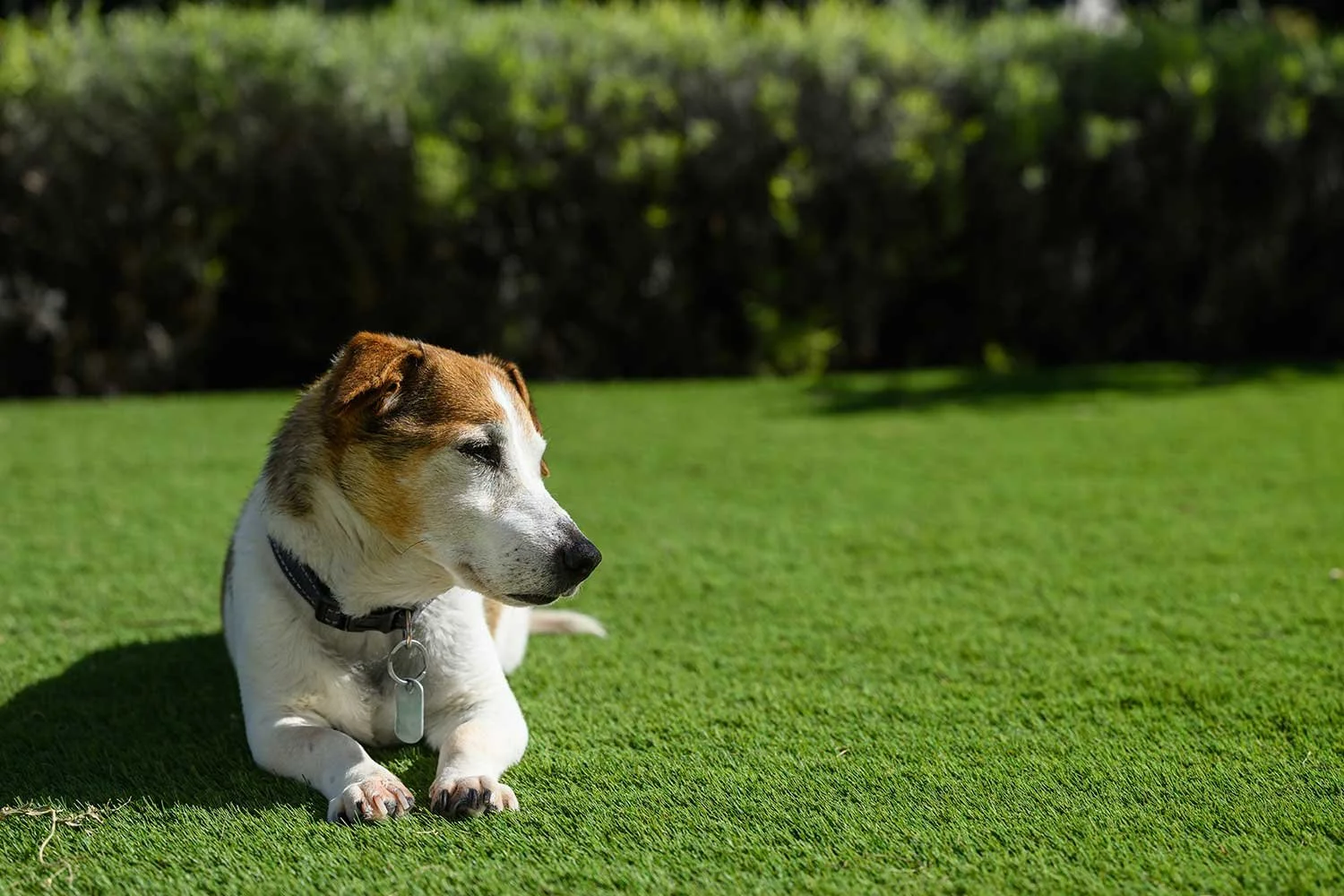
When Can Pets Go Back on the Grass After Treatment?
Why Licensing Is the Real Answer
Every product applied to a domestic lawn in the UK has been through an approval process before it can be sold or used, and that process is not a formality.
Manufacturers have to demonstrate what happens to the active ingredient in soil and water, what effect it has on non-target species including earthworms, birds, fish and pollinators, and what the exposure risk is to people and animals using the treated area. The Chemicals Regulation Division of the Health and Safety Executive reviews that evidence before granting approval, and products that cannot demonstrate it do not get licenced for domestic use.
So a product approved for use on a garden lawn has already been assessed against exactly the scenario people worry about: a household with children and animals using the space afterwards.
Here is the argument that settles it for most people. If a treated lawn genuinely posed a risk to a dog, what about next door’s cat? It can be over the fence and across your lawn within minutes of the technician packing up, and nobody can stop it. If that created a real hazard, the product would never have been licenced for use in domestic gardens in the first place.
The licensing system exists precisely because nobody can control what walks across a lawn after treatment. The products have to be safe on that basis, and they are assessed on that basis.
Where the Risk Actually Sits
There is a point in the process where the chemistry needs respecting, and it is worth understanding where it is, because it is not on your lawn.
The risk is in the concentrate. When our technician is measuring and mixing product with water before application, that is the point at which the material is in its strongest form and needs handling properly. It is why operators are legally required to hold PA1 and PA6 pesticide certification, why they wear protective equipment while mixing, and why the product is transported and stored the way it is.
By the time it reaches your lawn it has been diluted enormously. What goes through the sprayer is a very small amount of active ingredient in a very large amount of water, applied at a measured rate across the whole area. The difference between the concentrate in the container and the spray landing on the grass is not marginal. They are different propositions entirely.
This is the part most online advice misses. It treats the product on the lawn as though it were the product in the bottle, and then builds a lot of unnecessary caution on top of that mistake.
What About Granular Fertiliser?
The same principle applies and the practical answer is reassuring.
Granular feed is safe on a treated lawn. For it to cause any problem at all, a dog would first have to eat it, which most have no interest in doing, and then eat a meaningful quantity of it, which is considerably less likely again given it is spread thinly across a large area rather than left in a pile.
If an animal did manage to eat enough to have any effect, the most likely outcome by some distance is an upset stomach or being sick. That is not something to dismiss entirely if you have a dog that eats everything it finds, but it is a very different concern from the one people usually arrive with.
Common sense still applies, as it would with anything. Do not leave an open bag where an animal can get at it, which is a different situation entirely from a lawn that has been treated.
The Two Reasons We Still Ask You to Wait
So if the products are safe, why do we ask you to keep off the lawn for a few hours after a visit? Two reasons, and neither of them is about harm.
Iron staining
Our moss control is an iron sulphate treatment applied as a liquid, and iron stains.
While the treatment is still wet on the surface, it can be picked up on shoes and on paws and carried onto whatever comes next. On pale paving, decking, porcelain patio slabs, light carpet or a cream hallway floor, that shows, and iron marks are not easy to remove once they have set.
This is the genuine practical reason to stay off a lawn after a moss treatment, and it applies to people as much as to pets. If the dog does go out, wiping its feet before it comes back indoors or crosses a pale patio solves it entirely.
Treatment effectiveness
The second reason is about getting your money’s worth.
Weed control works by being absorbed into the leaf of the weed, and that takes time. If the product is wiped off the surface before it has been taken up, the treatment is less effective and the weed may survive. The same applies to foliar nutrition, which also needs time on the leaf.
A dog running across a lawn, and particularly one lying down or rolling on it shortly after a treatment, wipes product off exactly the surfaces it needs to stay on. You are not putting the dog at risk. You are reducing the result you have paid for, and in some cases enough to need the area treating again.
What We Actually Ask
Our advice is straightforward and it is about results and clean floors rather than safety.
Keep off the lawn until the treatment has dried, which in reasonable conditions is usually a couple of hours. If it has been applied in damp or still weather it may take longer, and the technician will tell you if that is the case.
If a pet does go out before then, wipe its feet before it comes indoors or crosses pale surfaces. If you can keep them off for a few hours after a weed control application, the treatment works better.
That is the whole of it. No exclusion period, no waiting days, and nothing to worry about if the dog slips out while your back is turned.
A Note on Where This Confusion Comes From
Plenty of lawn care information online recommends long exclusion periods, sometimes days, and advises keeping animals off treated grass as a safety measure.
Some of that is American content describing different products under a different regulatory system. Some of it is caution written by people who are not qualified to apply the products and are sensibly not claiming otherwise. And some of it is simply the gap between what is in the container and what ends up on the lawn being misunderstood.
If you are ever unsure, the right question to ask any lawn care provider is what product they are using, whether they hold PA1 and PA6 certification, and what the label actually says. A professional will answer all three without hesitating. We will.
How We Work
Our technicians are qualified to City and Guilds NPTC standard, holding PA1 and PA6 certification for the safe use and application of pesticides. We work to BASIS Lawn Assured accreditation and the Amenity Standard, both of which require documented procedures for product handling, application rates and record keeping.
Our wider approach is organic where possible and reduced input across the board. We use low salt index fertilisers that protect soil biology rather than suppressing it, add carbon and compost to feed the soil, and keep chemical and fungicide use to a minimum. That is partly an agronomic decision and partly because a lawn that is genuinely healthy needs less intervention over time.
If you have specific concerns, tell us at the assessment. We will explain exactly what is being applied and why, and where there is a reasonable alternative we will talk you through it.
We have been established since 2016, we are independent and family owned rather than a franchise, and we cover Hampshire, West Sussex and West Surrey along with Berkshire and the Thames Valley. We hold City and Guilds NPTC pesticide qualifications including PA1 and PA6, and BASIS Lawn Assured accreditation, carry full insurance through NFU Mutual, are licensed waste carriers, and are members of the UK Lawn Care Association, whose committee Ian Kenyon sits on.
Frequently Asked Questions
Once the treatment has dried, which in reasonable conditions is usually a couple of hours. That is not a safety exclusion period. It is so that iron in the moss control does not get carried onto pale floors and patios, and so that weed control has time to be absorbed into the leaf rather than being wiped off.
Yes. Every product applied to a domestic lawn in the UK has to be licenced, and that approval requires evidence on exposure to non-target species including pets and wildlife. A product that could not demonstrate that would not be approved for domestic use. Everything we use is safe for everything that uses your garden.
Nothing happens, and this is the clearest way to think about the whole question. Nobody can stop a neighbour’s cat crossing a treated lawn within minutes. The licensing system exists on that basis, and products are assessed against exactly that scenario. If it were genuinely hazardous, the product would not be licenced for garden use.
In practice, no. A dog would need to eat it in the first place, which most will not, and then eat a meaningful quantity, which is unlikely given it is spread thinly across a large area. If an animal did eat enough to have an effect, the most likely outcome by far is an upset stomach or being sick. Keeping an unopened bag out of reach is simple common sense, and is a different situation from a treated lawn.
A lot of that advice comes from American sources describing different products under a different regulatory system, or from people who are not licenced applicators and are being understandably cautious. Some of it also confuses the concentrate in the container with the heavily diluted product that reaches the grass. They are not the same thing.
In the concentrate, during mixing, which is why operators must legally hold PA1 and PA6 certification and use protective equipment at that stage. Once mixed, the product is a very small amount of active ingredient in a large volume of water, applied at a measured rate. The material on your lawn is a different proposition from the material in the container.
It can reduce the effect, which is the practical reason to wait. Weed control needs time to be absorbed into the leaf, and an animal running, lying or rolling on the lawn shortly after application wipes product off the surfaces it needs to stay on. The treatment is not dangerous to the dog. The dog is just making it work less well.
Yes, and for the same reasons. The products are licenced on the basis that treated areas are used by households including children. The practical advice is identical: wait until it has dried, mainly so that iron from moss control does not get walked onto pale floors.
Worried about pets and lawn treatments?
Tell us at the assessment. We will explain exactly what is being applied and why, and give you the simple practical steps that keep floors clean and treatments working.




 Made with love by:
