

 Established 2016
Plenty of people want to get rid of lawn moss without chemicals, and the reason is usually some combination of children, dogs, pollinators and a general preference for not spraying things on a garden the family uses. It is a reasonable position, and the short answer is that you can reduce moss a long way with mechanical work alone. Whether you can clear it entirely that way is a different question, and the honest answer to that one is less comfortable.
Here is what actually works, in the order it needs doing, along with a straight assessment of the home remedies that circulate online and where iron sulphate really sits in all this, because it is not the thing most people assume it is.
🎧 Prefer to listen? Get the full guide in your ears
Can You Get Rid of Lawn Moss Without Chemicals?
The Honest Answer First
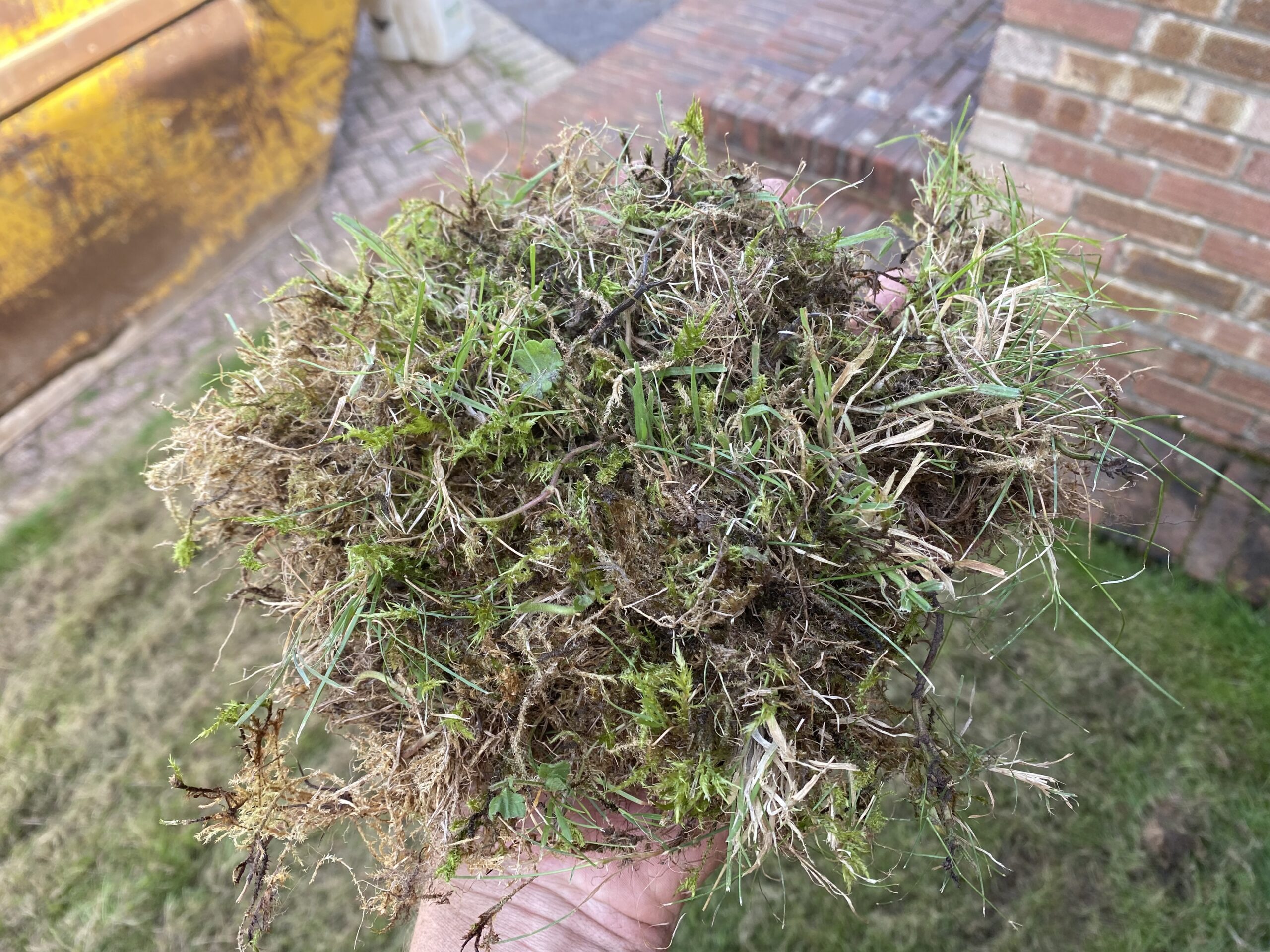
Removing moss is the easy part. You can rake it out of a lawn in a weekend with nothing but a spring-tine rake and some determination.
Keeping it out is the actual job, and no amount of raking achieves that on its own. Moss is not a lawn disease that arrives and needs killing. It is an opportunist that colonises space the grass has failed to hold. Wherever conditions favour moss over grass, moss wins, and it keeps winning until those conditions change.
So a chemical-free approach is not one action. It is the removal, followed by a series of changes to the growing conditions. Do the removal and skip the rest and the moss is back within a season, which is exactly what happens to most people who try it.
Why the Moss Is There in the First Place
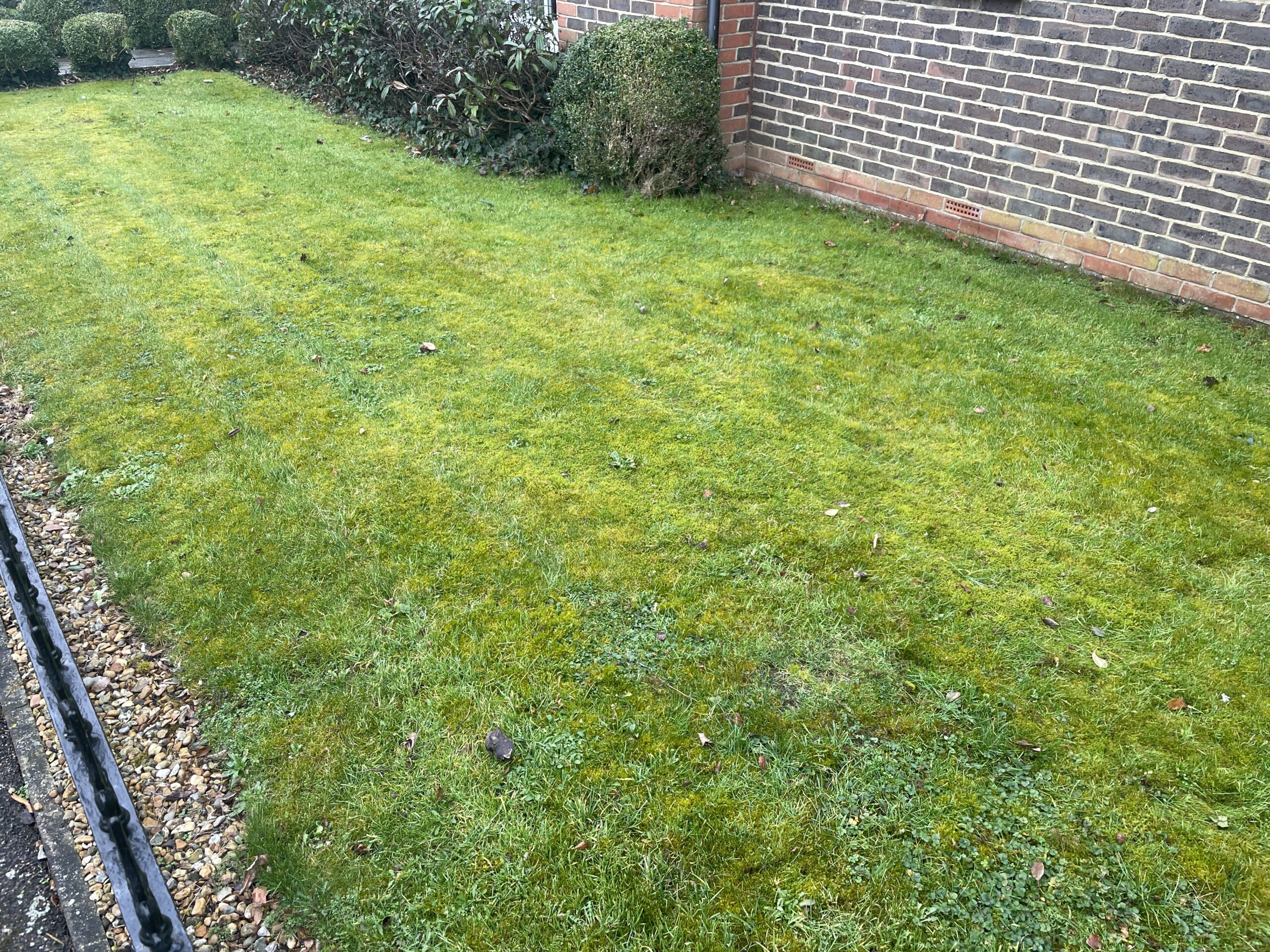
Moss thrives where grass struggles. Every one of the following tilts the balance in its favour, and most mossy lawns have three or four of them at once. These are the seven causes we check for on every lawn we assess.
- Shade. Grass needs light to photosynthesise. Moss does not need much at all.
- Poor drainage. Standing water and permanently damp surfaces are ideal for moss and hostile to grass roots.
- Compaction. Squeezed soil means shallow roots, weak grass, and gaps for moss to occupy.
- Mowing too short. Scalped grass cannot photosynthesise properly and leaves the soil surface exposed to light, which moss spores need to establish.
- Poor nutrition. Underfed grass thins out, and thin grass leaves space.
- Acidic soil. Grass prefers a pH near neutral. Moss tolerates acidity far better.
- Bare patches. Any gap in the sward is an opening, and moss colonises bare ground faster than grass does.
Work out which of these apply to your lawn before you start. The removal is the same regardless, but which of the steps below matters most depends entirely on your particular combination.
Step One: Open the Soil Up
Compaction and poor drainage are the two causes most people overlook, and between them they account for a great many mossy lawns that are not especially shaded. They also come first, before any raking, because relieving the ground while the surface is still intact gets the tines to full depth, and whatever removal follows then clears the surface and the cores in one go.
Aeration is the fix, and it is purely mechanical, which makes it the single most useful chemical-free intervention available. Hollow tines pull plugs of soil out of the lawn, which is the strongest option on badly compacted ground because material is physically removed. Solid and chisel tines take nothing out but displace the soil, opening cracks and fissures around the channel that roots then follow, and they leave a far tidier surface. Which one suits your lawn depends on the ground rather than on a default setting.
One point worth correcting, because it is repeated everywhere. Sandy soils compact too. The idea that free-draining ground looks after itself is wrong, and we aerate every lawn every year as standard rather than treating it as something only heavy clay needs.
You can do this with a garden fork on a small lawn, pushing it in to full depth and rocking it slightly every ten to fifteen centimetres. The rocking is the part that matters, because it is what fractures the soil around the hole. It is slow and hard work but it costs nothing.
On lawns with a persistent surface damp problem, top dressing after aeration improves surface drainage over time and is worth repeating annually. A sand and loam or sand and compost blend is used depending on what the lawn needs.
Step Two: Physical Removal
On a small lawn, a spring-tine rake is all you need. Work in one direction across the whole lawn, pulling firmly enough to drag the moss out rather than skim over it, then go again at right angles to the first pass. Expect this to be hard work and expect to fill more bags than you anticipated.
On a medium or large lawn, hand raking is impractical and a powered scarifier is the sensible option, either hired or through a lawn care company. It removes far more material, faster, and at a consistent depth, and it will break up and lift the cores from the aeration pass at the same time.
Two things to know. The lawn will look dreadful immediately afterwards, thin and brown and torn up, and that is normal. And raking does not kill moss, it removes the visible growth. Fragments left behind will regrow, which is why the steps that follow matter more than this one does.
Timing matters. The grass needs to be growing well enough to recover, which gives a spring window from the end of February to the start of May and an autumn window from late August to the start of November. Never scarify in heat or drought, and raking moss out in the middle of winter leaves bare soil sitting open through the wettest months, which is an invitation for the moss to come straight back.
Once the material is out, clear it up properly. Leaving heaps of moss and thatch on the surface undoes the point of removing them.
Step Three: Deal With the Light
Shade is the hardest cause to fix and the one that most often defeats chemical-free moss control, because no amount of raking, feeding or aerating will beat a lawn that gets two hours of light a day.
Where the shade comes from overhanging branches, crown lifting or thinning the tree makes a real difference and is worth doing while the tree is dormant in winter. Where it comes from a fence, a wall or the house itself, the options are limited. Shade-tolerant grass seed, typically with a high proportion of fine fescues, will hold on where standard ryegrass mixes give up, but it is a mitigation rather than a solution.
Clearing fallen leaves promptly matters here too, since a layer of wet leaves creates exactly the dark damp conditions moss wants.
If an area cannot get more than a few hours of light, the realistic choice is to accept some moss there, or to plant that corner as a bed rather than fighting for grass in a place grass does not want to grow.
Step Four: Raise the Mower
The easiest change on the list, one of the most effective, and it costs nothing at all.
Cutting too short is a major contributor to moss. Short grass has less leaf area, photosynthesises less, produces less energy and develops shallower roots. It also lets light reach the soil surface, which is precisely what moss spores need to germinate.
Raise the cut so the grass sits at around four to five centimetres through most of the year and the sward gets denser, shading the soil surface and physically denying moss the light it needs. Never remove more than a third of the leaf in a single cut, never mow short into moss, and keep the blades sharp, because torn grass recovers more slowly than cleanly cut grass.
Step Five: Feed the Grass So It Outcompetes the Moss
There is no way to make a lawn moss-free by weakening the moss alone. The reliable route is to make the grass strong enough to hold the space itself. A thick lawn prevents almost every problem, and moss is a symptom of a struggling one.
A well-fed lawn grows densely, and dense turf leaves nowhere for moss to establish. Organic and plant-based fertilisers work perfectly well for this and have the added benefit of feeding soil biology rather than suppressing it. High salt index synthetic products can damage the soil bacteria that keep the whole system working, which is counterproductive when the aim is a lawn that defends itself.
If your soil is acidic, and a simple pH test kit will tell you in ten minutes, correcting it moves conditions back towards grass and away from moss. Any adjustment should be made on the basis of a test rather than guesswork, because overcorrecting brings its own problems.
Step Six: Deal With Bare Patches and Overseed
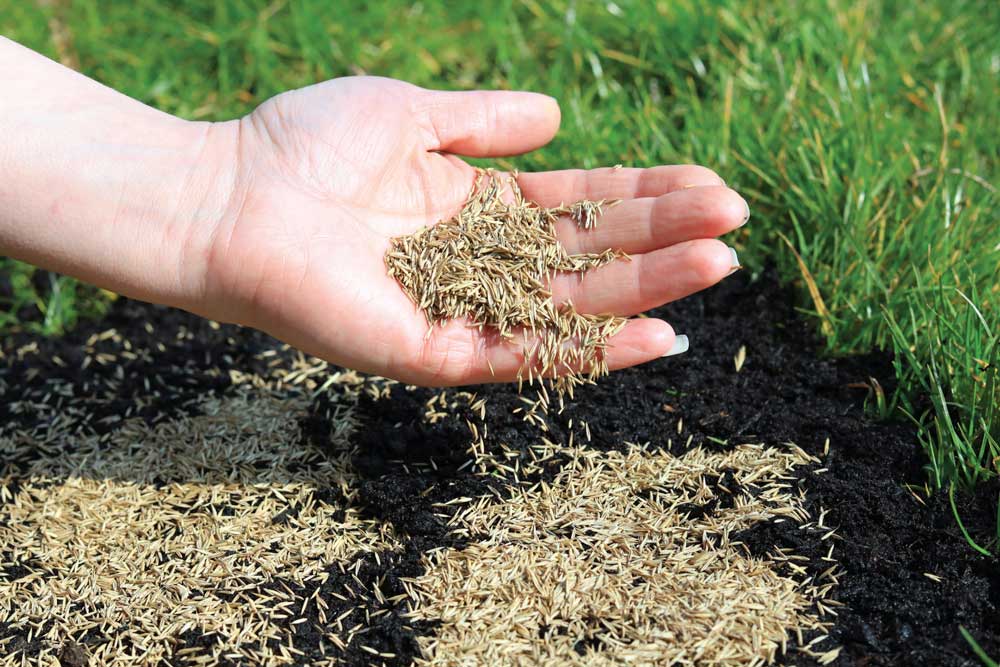
Removing moss leaves bare ground, and bare ground gets colonised by something. Left to itself, that something is usually moss again, or weeds. Dealing with bare areas quickly is one of the core principles behind keeping moss out for good.
Overseeding immediately after removal is what closes the loop. Seed sown into a freshly raked or scarified surface makes proper soil contact and germinates well, and the resulting grass occupies the space before the moss can return. The aeration holes help here too, because they hold moisture around the seed that falls into them. On shaded lawns, choose a shade-tolerant mixture rather than a general purpose one.
Keep the area watered until the seedlings establish. Autumn sowing usually gets enough natural rainfall in the UK. Spring sowing often does not.
Iron Sulphate Is a Chemical, and It Is What We Use
This is the question that comes up more than any other on this topic, and it deserves a straight answer rather than a comfortable one.
Iron sulphate is a chemical. It is a mineral compound rather than a synthetic herbicide, and it works differently from a weedkiller, dehydrating the moss rather than being taken up and moved through a plant. But it is a chemical treatment, applied at a measured rate by a qualified technician, and we are not going to dress it up as anything else.
It is also what our own moss control service is built on, so this article is not us telling you to avoid something we sell. Everything above is genuine, useful work that reduces moss and, done properly, keeps a lot of it out. What it will not do is clear a heavy infestation as quickly or as completely as a treatment will, and if you want that result you are choosing a chemical treatment. Those are the two honest options and it is worth knowing which one you are picking.
Two practical notes if you do use it. A concentrated liquid applied evenly is considerably better than lawn sand, which works but is difficult to spread evenly and can scorch the grass where it lands heavily. And it goes on after the scarifying and clearing up, not before, so the bulk of the moss has already been lifted out mechanically and the treatment deals with what is left.
Iron sulphate also greens the grass and strengthens the plant against winter disease, because iron is a nutrient grass needs. That is a genuine second benefit rather than a selling point bolted on, and it is why the treatment sits in the seasonal plan rather than being kept back for emergencies.
Home Remedies That Do Not Work
These circulate widely and are worth addressing directly, because several of them will damage your lawn.
Vinegar. Acetic acid is a non-selective contact killer. It will brown the moss and it will brown the grass alongside it. It also acidifies the surface, which is the opposite of the direction you want soil pH to move. The most counterproductive suggestion on the list.
Salt, or salt and water mixtures. Salt kills moss and grass alike, damages soil bacteria, and persists in the soil, causing problems for anything you try to grow there afterwards. Avoid it.
Baking soda. Sodium bicarbonate has some effect on moss on hard surfaces such as patios. On a lawn it is a sodium source, with the soil problems that brings, and the results are patchy at best.
Washing-up liquid. Household detergent damages the waxy coating on grass leaves that protects them from water loss and disease. It is sometimes suggested as a wetting agent, but domestic detergent is not formulated for turf and does more harm than good.
Boiling water. Effective on individual weeds in paving cracks. On a lawn it kills grass, moss, soil organisms and everything else it touches.
The pattern is consistent. Anything that kills moss by direct contact will kill grass by direct contact too, because both are plants. Chemical-free moss control works by changing conditions, not by finding a household substance that discriminates between species.
A Realistic Timeline
Worth knowing what to expect, because the main reason people abandon this approach is that they expected it to be faster.
Removal takes a weekend and gives an immediate but ugly result. Overseeding germinates within two to three weeks in autumn. The lawn looks presentable again after roughly six weeks. Real improvement in density, meaning the point at which the grass is winning, typically takes two full growing seasons, and shaded areas may never quite get there.
A programme that includes moss treatment alongside the mechanical work usually clears visible moss within a fortnight and keeps it suppressed through the winter while the cultural changes take effect. The purely mechanical route reaches a similar place eventually, but it takes longer and it needs you to keep doing the maintenance every year.
How We Approach It
Our philosophy is cultural work first, chemicals second, which is not the same as chemical-free. An autumn renovation covers four operations: scarification, aeration, overseeding and top dressing, and those do the structural work that decides whether moss comes back. We also use a plant-based, low salt index fertiliser, because feeding soil biology produces a lawn that resists moss on its own.
Our moss control is a liquid treatment of iron sulphate with wetting agents that help it penetrate thick moss, applied in autumn, winter and early spring when moss is most active. It goes on after the scarifying and clearing up, and it also improves grass colour and strengthens the plant against winter disease, which is why it earns its place in the plan rather than being a one-off rescue.
If you would rather keep treatments to a minimum, say so at the assessment. We can weight the work towards the mechanical side and the nutrition, and be clear with you about what that will and will not achieve on your particular lawn. What we will not do is describe a moss programme as chemical-free when iron sulphate is doing part of the job.
We have been established since 2016, we are independent and family owned rather than a franchise, and we cover Hampshire, West Sussex and West Surrey along with Berkshire and the Thames Valley. Our technicians are City and Guilds qualified. We hold BASIS Lawn Assured accreditation, work to the Amenity Standard, and are members of the UK Lawn Care Association.
Frequently Asked Questions
You can remove it, and the removal itself is straightforward. A spring-tine rake or a scarifier will take it out in a weekend. The part that takes commitment is keeping it out, which means fixing whichever of the seven conditions applies to your lawn. Do the raking and nothing else and it returns within a season, which is why so many people conclude the chemical-free route does not work when what actually happened is that they stopped after the removal.
Yes. It is a mineral compound rather than a synthetic herbicide, and it works by dehydrating the moss rather than being taken up and moved through the plant, but it is a chemical treatment and we would rather say so. It is what our own moss control uses, applied at a measured rate by qualified technicians, and it greens the grass and hardens it against winter disease at the same time.
It browns it, along with any grass it lands on, because acetic acid is a non-selective contact killer and moss and grass are both plants. You end up with dead moss sitting in dead grass and bare soil for the next lot of moss spores to colonise. It also acidifies the surface, which pushes soil pH in exactly the wrong direction. It is the most counterproductive of the home remedies and the one most often recommended.
No, and this is the single most useful thing to understand about moss. Raking removes what you can see. It does not change the shade, the drainage, the compaction, the mowing height or the nutrition that let the moss establish in the first place, and it leaves bare ground that moss colonises faster than grass does. Raking without overseeding often leaves a lawn mossier the following year than it was before.
It depends which part you mean. Raking and scarifying need the grass growing well enough to recover, which gives a spring window from the end of February to the start of May and an autumn window from late August to the start of November. Moss treatment is different and works when the moss is most active and visible, which means autumn, winter and early spring.
Aerate first. Relieving the compaction while the surface is still intact gets the tines to full depth, and the raking or scarifying that follows then clears the moss and breaks up the cores in the same pass, dropping organic matter into the holes to feed soil biology. It also means you are dealing with the cause before the symptom, which is the whole principle behind chemical-free moss control.
It does work, but it is difficult to apply evenly by hand and it can scorch the grass where it lands heavily, which leaves you with patches to repair. A concentrated liquid applied at a measured rate gives a more even result without the scorch risk, which is why it is what we use.
Not directly, in the sense that it is not a disease attacking the grass. What it does is occupy space, compete for light, water and nutrients, and hold moisture at the surface like a sponge so water and feed struggle to reach the roots. It clogs mowers, browns off in summer, and raises the risk of pests and disease. The bigger issue is what its presence tells you about shade, compaction, drainage or nutrition.
If the conditions that suited it are unchanged, certainly, and usually within a year. If you have opened the soil up, raised the mowing height, fed the lawn properly and overseeded the gaps, it comes back far more slowly and in far less of the lawn. Preventative treatment through autumn and early winter is what holds it back over the months when the grass cannot compete. In deep shade it will keep returning whatever you do.
Want to get on top of the moss in your lawn?
Our approach is cultural work first: aeration, scarification and clearing up, then an iron sulphate treatment that dehydrates what is left and greens the grass at the same time, followed by overseeding, top dressing and a plant-based feed. Early September opens roughly six weeks when conditions for this work are as good as they get all year.




 Made with love by:
