
 Established 2016
Scarifying and aerating get confused more often than any other pair of treatments we deal with, and it is easy to see why. Both usually get booked in the same visit. Both involve a machine being pushed across the lawn. Both leave the surface looking rough for a fortnight afterwards. From the kitchen window they look like the same job.
They are not the same job. They fix two entirely different problems, they work at different depths, and having one done when the lawn needed the other is one of the more expensive mistakes in domestic lawn care.
It comes down to depth. Scarifying works on the surface, in roughly the top ten to fifteen millimetres. It takes out dead organic material sitting between the green leaf and the soil. Aerating works below the surface, typically down to seventy five or a hundred millimetres. It opens channels into the soil so that air, water and nutrients can reach the roots. One takes something out. The other lets something in.
🎧 Prefer to listen? Get the full guide in your ears
Scarifying vs Aerating: What Is the Difference?
What Healthy Soil Is Actually Made Of
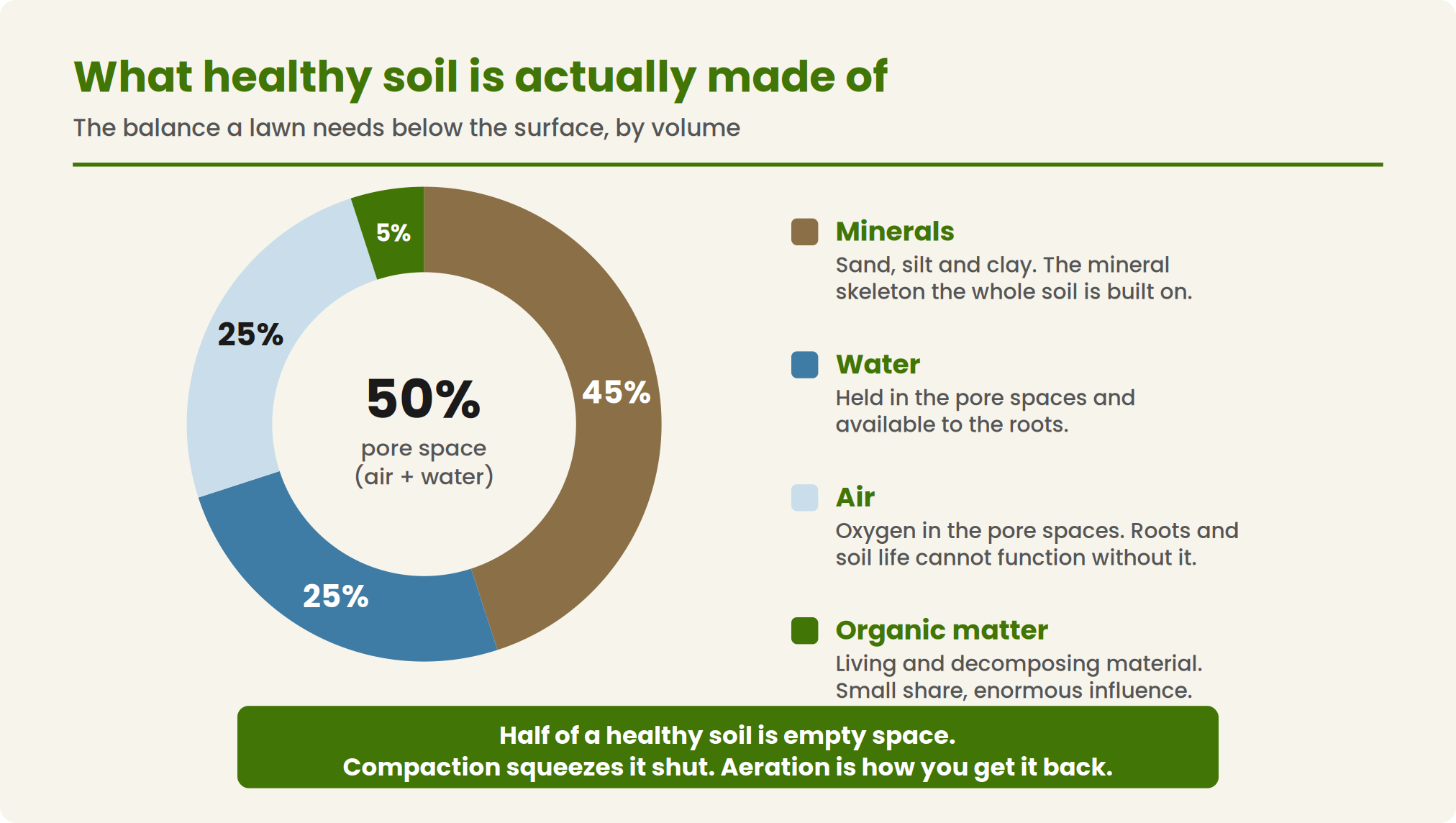
A healthy soil is roughly forty five per cent minerals, five per cent organic matter, twenty five per cent water and twenty five per cent air. The mineral fraction is the sand, silt and clay that gives the soil its body. The organic fraction is small but does a disproportionate amount of the work, feeding the biology that makes nutrients available to the plant.
The number that matters here is the other fifty per cent. Half of a good soil is pore space, shared between air and water. Roots do not grow through soil particles, they grow through the gaps between them, and they need oxygen at the root surface to function at all.
Compaction is what happens when that space gets squeezed shut. The mineral fraction does not change, but the pore space collapses, and with it goes the soil’s ability to hold air, take in water and support root growth. What you get instead is shallow, weak rooting, poor drainage, reduced microbial activity, and a lawn that struggles in drought and heavy rain alike.
What Scarifying Does
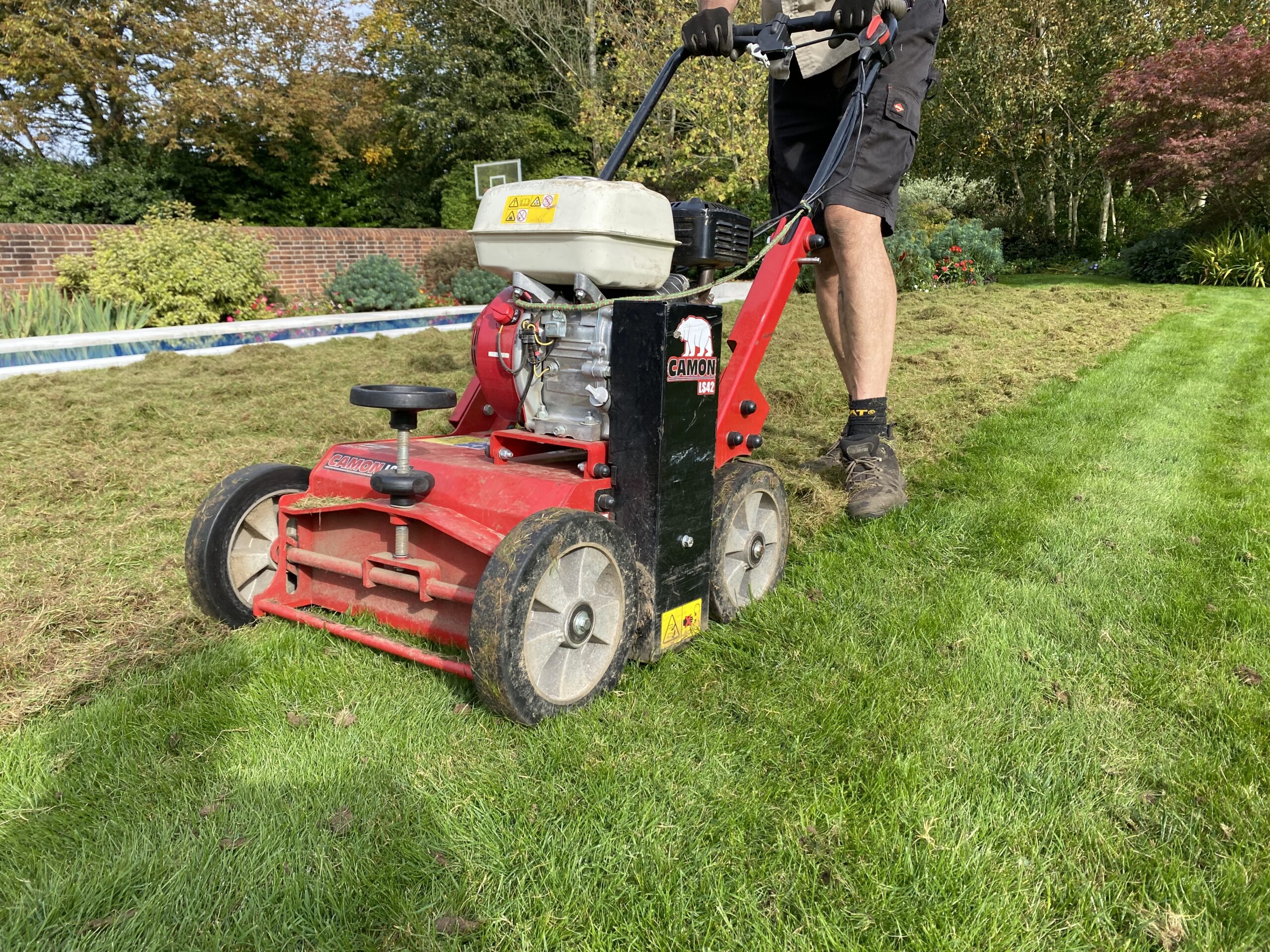
A scarifier uses vertical blades spinning at speed to cut down through the sward. Those blades rake out thatch, the layer of dead grass stems, decayed moss, old roots and general plant debris that builds up on the soil surface faster than soil bacteria can break it down.
A small amount of thatch is a good thing. It cushions the surface and protects the crowns. Once the layer passes roughly ten to twelve millimetres it starts working against the lawn. Water runs off instead of soaking in. Fertiliser lodges in the thatch instead of reaching the root zone. And the grass starts rooting into the thatch itself, which dries out far faster than soil, so the lawn becomes noticeably more drought-prone than it should be.
Scarification is also how dead moss comes out. Moss treatment kills moss, but killing it and removing it are two separate jobs. Left where it is, dead moss forms a dense mat that behaves exactly like thatch and blocks light from the grass underneath. On a small area a vigorous hand rake will do it. On anything larger a powered scarifier is the practical answer.
The lawn looks alarming afterwards. A remarkable quantity of material comes out and what is left looks sparse and torn. That is normal and temporary, and what has gone is dead material rather than living grass.
When Scarification Can Be Done
Scarification can be carried out at any time the grass is growing well enough to recover from it, and that recovery is the whole constraint. Take a heavy pass out of a lawn that is not growing and it will simply sit there looking damaged.
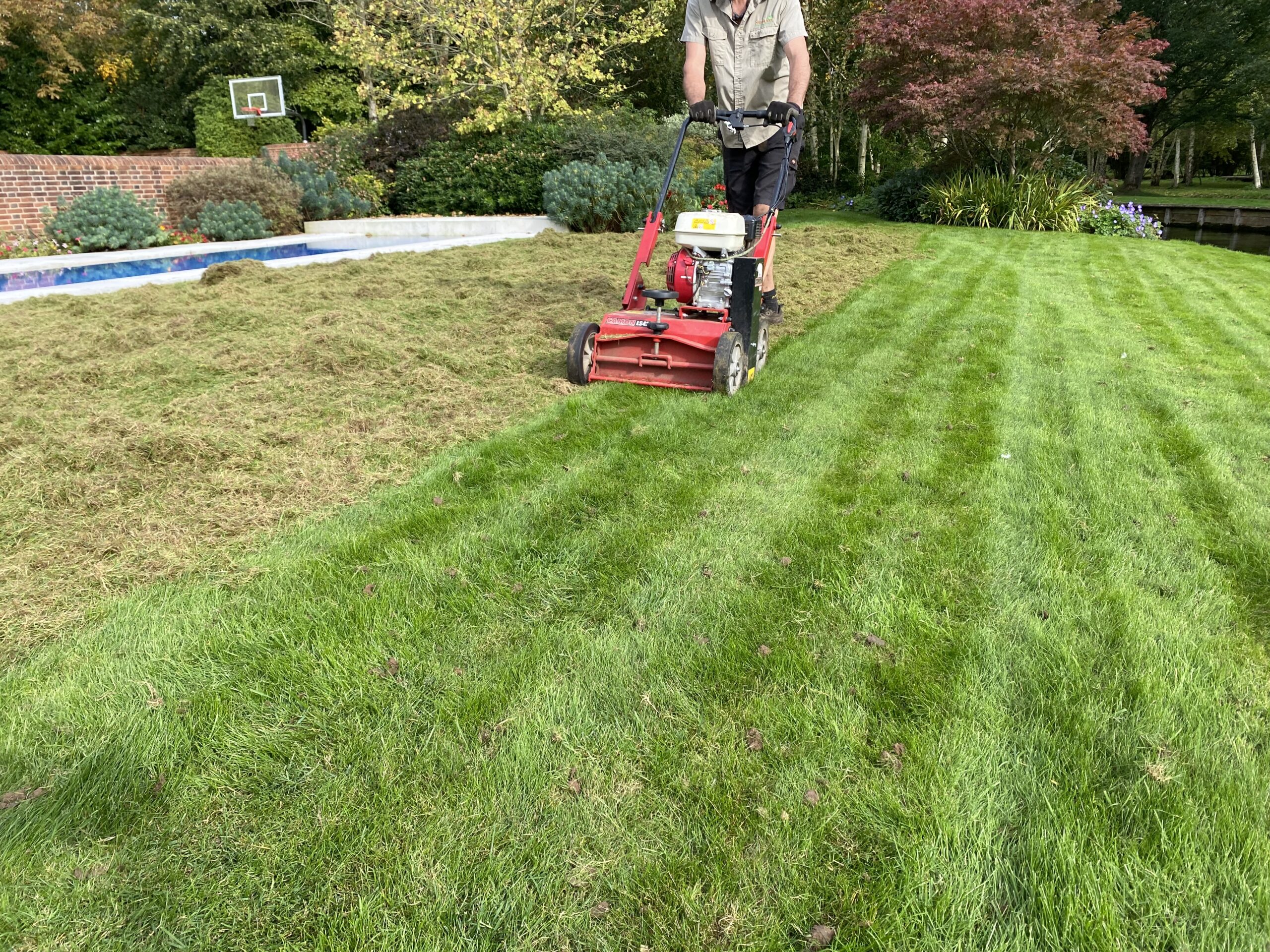
In practice that gives two productive windows in the UK. The spring window runs from the end of February to the start of May. The autumn window runs from late August to the start of November, and it is the stronger of the two, because the soil is warm, moisture is rising and there is time for the lawn to recover and thicken before winter.
Outside those periods the question is always the same: is this lawn growing enough to come back from it? In a mild season the answer is yes more often than the standard advice suggests.
What Aeration Does
Aeration deals with compaction. Years of foot traffic, mowing, garden furniture, children, dogs and rain hammering the surface press the soil particles together and close up the gaps between them. Aeration puts channels back into that ground so air, water and nutrients can move through it again.
On a compacted lawn that single change alters how the grass responds to everything else you do. Fertiliser reaches the root zone instead of sitting on the surface. Rain soaks in instead of running off towards the edges. Roots grow downwards instead of matting in the top few centimetres where they are vulnerable to every dry spell.
The tine does the work, and there is more than one kind.
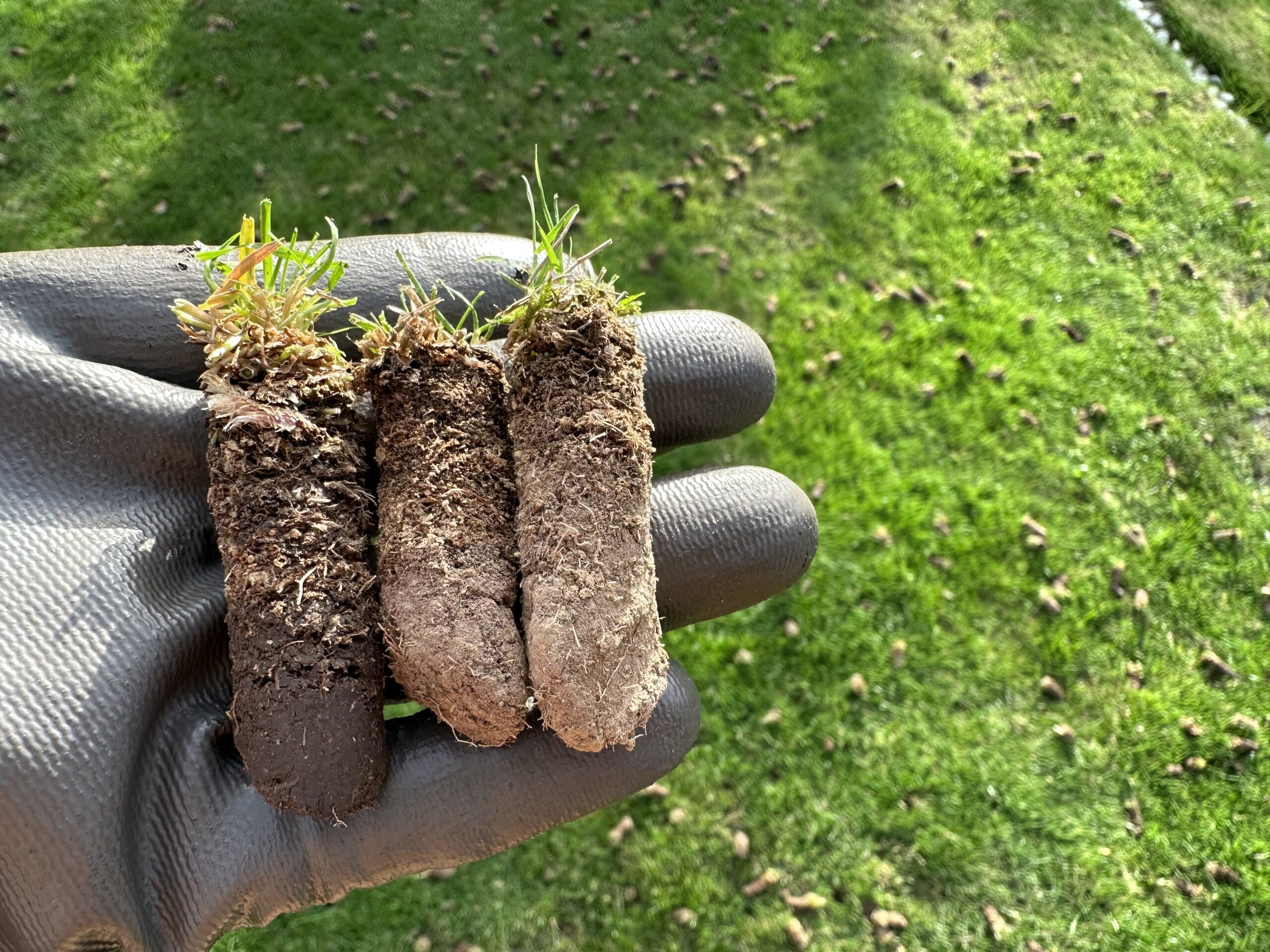
Hollow tines are cylindrical and pull a plug of soil out of the lawn, leaving an open channel behind. Because material is physically removed, the surrounding soil has somewhere to expand into. That makes them the strongest option on heavily compacted ground and on any lawn that has never been aerated properly. The cores come out onto the surface and need dealing with.
Solid tines and chisel tines do not remove anything. They displace the soil sideways and downwards, and that displacement fractures the ground around the channel, opening cracks and fissures through the surrounding soil. Those fissures are the useful part. They are lines of least resistance that roots will follow, so the effect reaches well beyond the width of the tine itself. This is quicker than hollow tining, leaves the surface far tidier, and suits lawns in reasonable condition or that need to stay presentable.
Slit or knife tines cut vertically rather than punching a round hole. They work well as a lighter, more frequent treatment between deeper visits, and they are particularly useful for surface drainage through the winter.
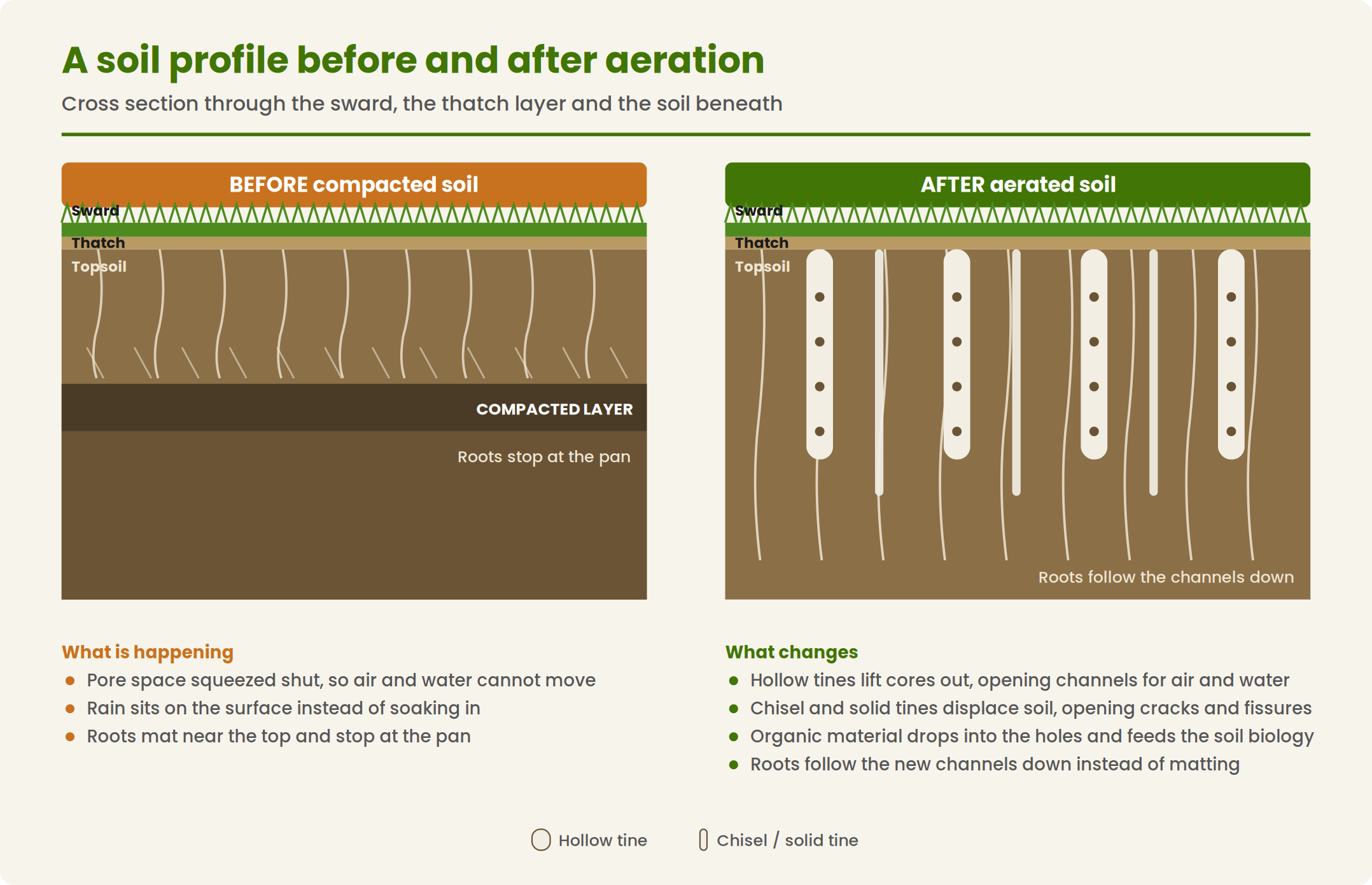
Which tine goes in the machine is a decision made after looking at the lawn rather than a default setting. On heavy clay, working a dressing into the holes after aeration is the single most useful long-term thing you can do to the soil. The blend is chosen for the problem, usually sand and loam or sand and compost, because it keeps the channels open instead of letting them close again under the next few months of use.
When Aeration Can Be Done
Aeration is not locked to a season. It can be carried out at any time of year provided the soil conditions are right, and the conditions matter far more than the calendar.
What you need is soil with some moisture in it. Ground that is frozen will not take a tine. Ground that is saturated will smear rather than fracture, and you lose the fissuring that makes the job worthwhile. Ground baked hard through a long dry spell will stop the tines short of depth or refuse them altogether. Between those extremes, which in most UK gardens covers a great deal of the year, the job is available.
That flexibility is genuinely useful. A lawn that missed the autumn does not have to wait a full twelve months for its compaction to be dealt with.
Which Does Your Lawn Need?
The two problems produce quite different symptoms, and a few minutes in the garden will usually tell you which you are dealing with.
Signs you need scarification
- The lawn feels spongy or bouncy underfoot, like walking on a thin mattress
- Visible moss, or a brown fibrous layer when you part the grass with your fingers
- Water sits on the surface briefly then disappears rather than soaking straight in
- Fertiliser seems to have less effect than it used to
- Cutting a wedge of turf with a spade shows a brown layer more than twelve millimetres thick between leaf and soil
Signs you need aeration
- Water pools on the surface after rain and stays there for hours
- The soil is hard to push a screwdriver or garden fork into, particularly when dry
- Grass is thin or worn along paths, gateways and other high traffic routes
- The lawn dries out and browns much faster than neighbouring lawns in summer
- Moss is establishing in areas that are not especially shaded
The Two Problems Feed Each Other
In practice, most established UK lawns over about five years old need both, and the reason is that each one makes the other worse.
Compacted soil has poor air movement and low microbial populations, so thatch decomposes more slowly and builds up faster than it otherwise would. That thicker thatch layer then holds water at the surface, which encourages exactly the conditions that keep the soil below it airless and compacted. Treat only one and you leave the cause of the other in place.
It is why an autumn renovation programme normally combines both rather than offering them as alternatives.
Can You Aerate Without Scarifying?
Yes, and there are situations where it makes sense. A lawn with genuinely low thatch, perhaps because it is young, mulch mown, or sitting on light sandy soil with strong microbial activity, may need nothing more than annual aeration.
The reverse is more of a problem. Scarify a badly compacted lawn without aerating and the result is short-lived. You take the thatch out, the lawn thins temporarily, then it struggles to recover because the roots still cannot get at air and water properly. Recovery is slow, any overseeding underperforms, and by the following autumn the thatch is building again because the soil biology never improved.
If the budget only stretches to one treatment and the lawn shows signs of both, aeration is usually the better single investment, because it deals with the underlying cause rather than the symptom.
The Combined Programme, and Why We Aerate First
Where both are needed, the order matters. Ours is aerate, then scarify, then overseed, then feed.
Most published advice has it the other way round, and the objection usually raised is that aerating leaves cores on the surface and running a scarifier over them drags soil about and clogs the machine. That is a fair concern with wet cores, and the answer is to let them dry before the scarifier goes on, which in decent working conditions means a matter of hours rather than days. Once they are dry the scarifier breaks them straight down.
We work in this order for two reasons. The first is practical. The cores have to be dealt with either way. Running the scarifier afterwards breaks them up and lifts them along with the thatch in the same pass, so you finish with one clean, level surface instead of a separate collection job.
The second is about what happens below ground, and it is the more important of the two. As the cores break down and the scarifier works the surface, some of that organic material drops into the open holes. That is exactly where you want it. It puts a food source down into the root zone for the soil biology, which is otherwise concentrated in the top couple of centimetres, and it starts building organic matter at depth rather than at the surface where it would only become more thatch.
Seed applied after both jobs falls into the tine holes and the grooves left by the scarifier, which gives far better soil contact than broadcasting onto an untouched surface. A feed then supports establishment through the autumn.
What It Looks Like Afterwards
Worth setting expectations on, because both treatments look alarming immediately afterwards and this is the point at which people ring us worried.
After scarification the lawn looks thin and brown, with a great deal of debris pulled to the surface. That debris is dead material, not living grass, and the crowns the grass regrows from sit below the depth the blades reach. After aeration the lawn carries small soil plugs that look untidy until they are broken down or brushed in.
Combined, the lawn will look worse than it did beforehand for roughly two to three weeks. With overseeding and feeding applied at the same time you should see clear improvement by week three and full recovery inside six weeks, going into winter considerably stronger than it came out of the summer.
Why Professional Scarification and Aeration Produces Better Results
Professional machines go deeper and take out more material than hire or domestic equipment generally manages, but the machinery is not really the point. What makes the difference is knowing which of the two jobs a particular lawn actually needs, which tine suits the ground, how hard to set the scarifier against the thatch that is genuinely there, and what order to work in.
Our visits start with an assessment. Compaction, thatch depth, moss coverage, soil condition and how the garden is used all feed into what gets done and when, so you only pay for what your lawn actually needs. We have been established since 2016. We hold BASIS Lawn Assured accreditation, work to the Amenity Standard, and are members of the UK Lawn Care Association, and our City and Guilds trained technicians cover Hampshire, Surrey, West Sussex and Berkshire.
Frequently Asked Questions
Aerate first, then scarify. The scarifier breaks up and lifts the cores along with the thatch, so you finish with one level surface, and some of that organic material drops into the open holes where it feeds the soil biology at root depth. The usual objection is that cores clog the machine, which is true of wet cores and easily solved by letting them dry first.
No. This claim gets repeated a great deal and it is wrong. Solid and chisel tines displace soil rather than removing it, and that displacement fractures the ground around the channel, opening cracks and fissures that roots then follow, so the benefit reaches beyond the hole itself. The genuine limitation is that no material is taken away, so on severely compacted ground hollow tines will do more.
Aeration can go ahead at any time of year as long as the soil is neither frozen, saturated nor baked hard. Scarification needs the grass growing well enough to recover, which gives a spring window from the end of February to the start of May and an autumn window from late August to the start of November.
No, and it does the opposite. A roller compresses the soil, which is precisely the problem aeration exists to fix. Rolling has a narrow legitimate use on newly seeded or newly turfed ground to improve contact, and on cricket and bowling surfaces where a fast, true surface is the point. On a domestic lawn it makes compaction worse.
Seventy five to a hundred millimetres for a domestic lawn, which is what most professional machines are set up to reach. Deeper is not automatically better, because the compacted layer on a typical garden lawn sits within the top hundred millimetres or so. What matters more than depth is that the tine suits the ground it is going into.
For aeration, yes, up to a point. Driving a fork in, rocking it back and forth to open the hole and repeating across the lawn does relieve compaction, and the rocking is what creates the fissuring that makes it worthwhile. It is hard work and no core is removed, so it will not match hollow tining on badly compacted ground. On a small lawn it is worth doing. On anything over about a hundred square metres you will run out of enthusiasm long before you run out of lawn. For scarifying, a spring-tine rake works on a small area but will not reach thatch of any depth.
Not necessarily. Aeration once a year suits most established lawns and is hard to overdo. Scarification depends on how fast your lawn builds thatch, which varies with grass type, soil, and how the lawn is fed and mown. Measure it rather than guessing: cut a wedge of turf and look at the layer between leaf and soil. Under six millimetres, leave it. Over twelve, take it out. Many lawns need scarifying every other year and aerating every year.
They damage the appearance temporarily and improve the lawn permanently. What comes out during scarification is dead material, and the crowns the grass regrows from sit below the depth the blades reach. Aeration removes small cores or opens channels and leaves the surrounding turf intact. Both look worse before they look better, which is why timing them to a period of active growth matters.
On a thin lawn, yes. The surface you are left with is the best seedbed you will get all year: the thatch is gone, the soil is open, and the tine holes are pockets where seed sits in excellent contact with soil and holds moisture well. Seed goes down after both jobs, never before.
Not sure whether your lawn needs scarifying, aerating, or both?
Our autumn renovation programme combines aeration, scarification, overseeding and feeding in the right sequence for your lawn. We assess thatch depth and compaction first, so you only pay for what your lawn actually needs.







 Made with love by: