
 Established 2016
You finish mowing the lawn, step back to admire the result, and notice stripes. Light bands and dark bands running in alternating lines across the surface. For some homeowners this is exactly what they were hoping for, the kind of finish you see on professional sports pitches and well-kept ornamental lawns. For others it is unexpected, slightly puzzling, and occasionally a cause for concern.
The good news is that stripes after mowing are almost always either a deliberate effect or a straightforward, fixable issue. Understanding what causes them puts you in control of whether your lawn displays them or not, and whether the stripes you are seeing are decorative or diagnostic.
This guide covers everything UK homeowners need to know about lawn stripes: why they appear, how to create them intentionally if you want them, and how to diagnose the less welcome version when stripes indicate something that needs attention.
The Decorative Stripe: How It Works and Why It Looks Good
The alternating light and dark stripes seen on well-maintained lawns, cricket outfields, and professional football pitches are created by a simple optical effect. When grass blades are bent in one direction, light reflects off them differently than when they are bent in the opposite direction. Blades bent towards you appear lighter. Blades bent away appear darker. Alternate passes of the mower in opposite directions bend adjacent strips of grass in opposite directions, and the result is the characteristic striped pattern.
The effect is not about the colour of the grass itself changing. The grass is the same shade of green throughout. What changes is the angle of the leaf blade relative to the light source, and therefore the amount of light reflected back to your eye. This is why lawn stripes look dramatically different depending on where you are standing and the direction of the sun. Viewed from one end of the lawn they may be bold and crisp. Viewed from the side they flatten significantly.
This is also why the effect is more pronounced on some lawns than others. Fine-leaved, upright grass varieties such as fescues and bent grasses hold their blades at an angle that reflects light more dramatically. Broader-leaved ryegrass dominant mixes still stripe, but the effect is typically less defined.
What Creates the Stripe: Rollers and Rear Deflectors
The stripes appear when something bends the grass blades consistently in one direction after cutting. On most modern cylinder mowers and many roller-equipped rotary mowers, this is done by a rear roller that follows behind the cutting mechanism. As the mower passes over the grass, the roller presses the blades flat in the direction of travel. On the return pass in the opposite direction, the blades are pressed the other way, creating the alternating pattern.
Not all mowers create stripes. Hover mowers, which lift the grass for cutting, produce no directional pressure on the blades and leave no stripe. Many rotary mowers without rear rollers have limited striping effect because nothing presses the cut grass consistently in the direction of travel. If you want lawn stripes and your current mower does not produce them, a mower with a rear roller is the practical solution. Aftermarket striping kits, essentially weighted rollers or brush attachments that can be fitted to some existing mowers, are also available and can significantly improve the effect on mowers that currently produce only a faint stripe.
How to Create Better Stripes Intentionally
Mow in straight, parallel passes
The quality of a striped finish depends almost entirely on how straight and parallel the mowing passes are. Curved or wandering lines produce curved stripes that look irregular rather than crisp. The most reliable technique is to identify a fixed reference point at the far end of the lawn, a fence post, a tree trunk, or a patio edge, and walk towards it rather than looking down at the mower. Looking ahead rather than at your feet naturally produces straighter lines.
On the first pass, take time to establish the straightest possible line across the lawn. Each subsequent pass is made adjacent to the previous one, using the edge of the last stripe as a guide. The consistency of the spacing between passes matters as much as the straightness of each individual pass.
Alternate direction each mowing session
Mowing in exactly the same direction every time tends to push the grass blades persistently in one direction and can cause a subtle lean in the sward over time. Alternating the direction of mowing between sessions, or rotating the pattern by ninety degrees occasionally, keeps the grass growing upright and produces a more consistent, even surface. It also gives you the option of creating a chequerboard pattern by mowing at right angles to the previous session.
Mow when the grass is dry and upright
Wet grass lies flat and does not respond to roller pressure in the same way as dry, upright grass. Mowing in damp conditions produces a flattened, compressed look rather than crisp alternating stripes. Morning mowing after the dew has dried, or afternoon mowing on a dry day, produces the most defined stripe effect.
Height matters
Longer grass produces more visible stripes because there is more leaf blade to bend and reflect light. A lawn cut at four to five centimetres will show a considerably more pronounced stripe than one cut at two centimetres. This is another practical reason to keep the cutting height raised through summer, beyond the grass health benefits it brings: the visual result is actually better.
When Stripes Are Not Decorative: Diagnosing Problem Stripes
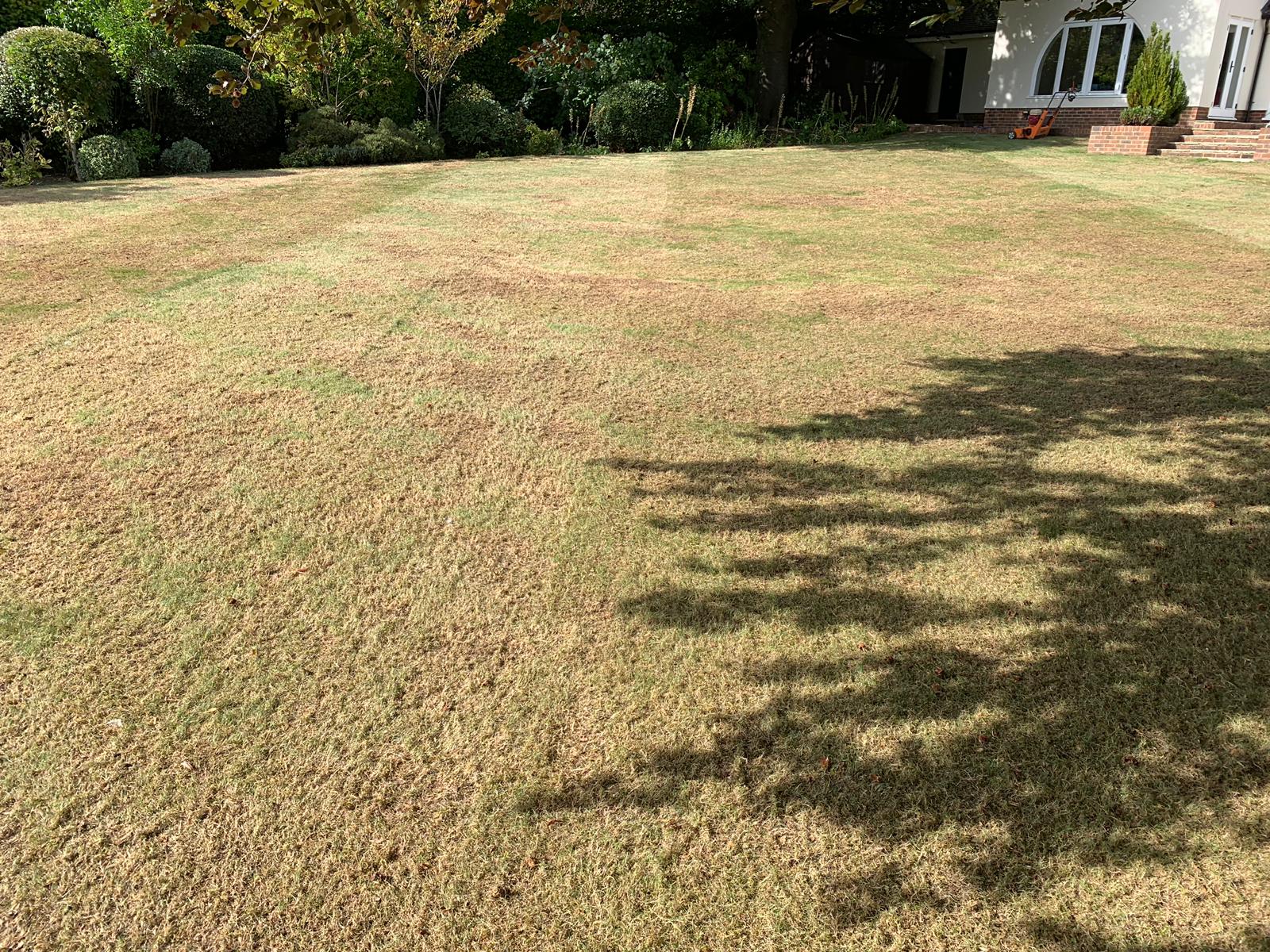
Not every striped appearance after mowing is the deliberate effect of alternating blade direction. Several common mowing problems produce stripe-like patterns that indicate something is wrong with the mower, the technique, or the lawn itself.
Uneven cutting height across the mower width
If the mower deck is not level, different areas of the cutting width are set to slightly different heights. The result is alternating strips of grass cut to different lengths, which appear as light and dark stripes. This is different from the roller-effect stripe in that it is more visible immediately after mowing and does not fade as the grass recovers. The affected areas look genuinely different in height rather than simply different in the angle of light reflection.
Checking deck levelness is straightforward. Set the mower on a flat, hard surface and measure the height from the ground to the underside of the cutting deck at each corner. If the measurements differ by more than a few millimetres, the deck needs adjustment. Most mowers have height adjustment points at each wheel that allow independent correction. On older or worn mowers, bent or corroded deck components can make consistent levelling difficult.
Missed strips between passes
A consistent light stripe of longer grass running the full length of a mowing pass indicates that a strip of grass was missed between two adjacent passes. This happens when the passes are spaced too far apart, when the mower wanders off the intended line, or when the overlap between passes is insufficient. The result is alternating strips of cut and uncut grass that look like stripes from a distance but are actually uneven in height.
The fix is straightforward: slightly overlap each pass with the previous one rather than aiming to butt them exactly together. A small overlap of five to ten centimetres ensures no strip is missed even if the mowing line is not perfectly straight.
Blunt or damaged blades
A blunt mower blade tears the grass rather than cutting it cleanly. The torn tips dry out and turn white or pale brown within a day or two of mowing, giving the lawn a bleached, streaky appearance that can look stripe-like in pattern. This is one of the most common causes of a lawn looking pale or dull shortly after mowing, and it is often mistaken for drought stress or disease.
The test is simple: look closely at the cut tips of the grass blades. Clean-cut tips are smooth and green. Torn tips from a blunt blade are ragged, frayed, and turn pale quickly. Sharpening or replacing the blade resolves the problem immediately. Mower blades should be sharpened at least once per season and checked after striking any hard object such as a stone or root.
Scalping on uneven ground
On a lawn with an uneven surface, raised areas are cut shorter than the surrounding grass by a mower set to a consistent height. These scalped ridges appear as pale or brown stripes following the contours of the uneven ground. They are most visible in dry conditions when the grass on the raised areas is already under additional moisture stress.
Scalping is both a cosmetic problem and a practical one. The exposed crowns on scalped areas are vulnerable to drought, disease, and invasion by moss and weeds. Addressing the underlying surface unevenness through top-dressing over multiple seasons gradually levels the lawn and eliminates scalping. In the short term, raising the cutting height reduces the severity of scalping on uneven ground.
Thatch and surface compaction producing uneven contact
On a lawn with a significant thatch layer, the mower wheels can sink into the soft thatch surface unevenly, causing the cutting deck to tilt slightly across its width and produce an inconsistent cut. The result can be faint stripe-like variation in cut height across the lawn surface. Scarification to remove the thatch layer resolves this over the following season and produces a firmer, more consistent surface for the mower to work on.
Improving the Overall Finish
The quality of a mowed lawn finish is the product of several factors working together. A well-maintained mower with sharp blades and a level deck, operated at a consistent pace on a reasonably even surface, in dry conditions, at an appropriate cutting height, with a rear roller to create a deliberate stripe, produces a result that looks genuinely professional.
Removing any one of these factors degrades the finish. A blunt blade produces torn tips. An unlevel deck produces uneven cutting height. Wet conditions produce compressed, matted grass. Too low a cutting height reduces the leaf area available for the stripe effect and stresses the grass. Getting all the variables right simultaneously is what separates a consistently excellent lawn finish from one that looks fine sometimes and disappointing at others.
Regular mowing, keeping to the one-third rule and never removing more than a third of the grass height in a single cut, also contributes to a better finish. A lawn that has grown long between cuts requires a more aggressive cut to bring it back to height, which stresses the grass, increases the risk of scalping on uneven areas, and produces a less refined result than a lawn cut frequently at a consistent height.
Why the Lawn Surface Matters
A consistently good mowed finish also depends on the quality of the lawn surface beneath the mower. A surface with humps, hollows, raised worm casts, and significant thatch is inherently difficult to mow to a consistent height. The mower follows the contours of the surface, cutting some areas too short and leaving others too long.
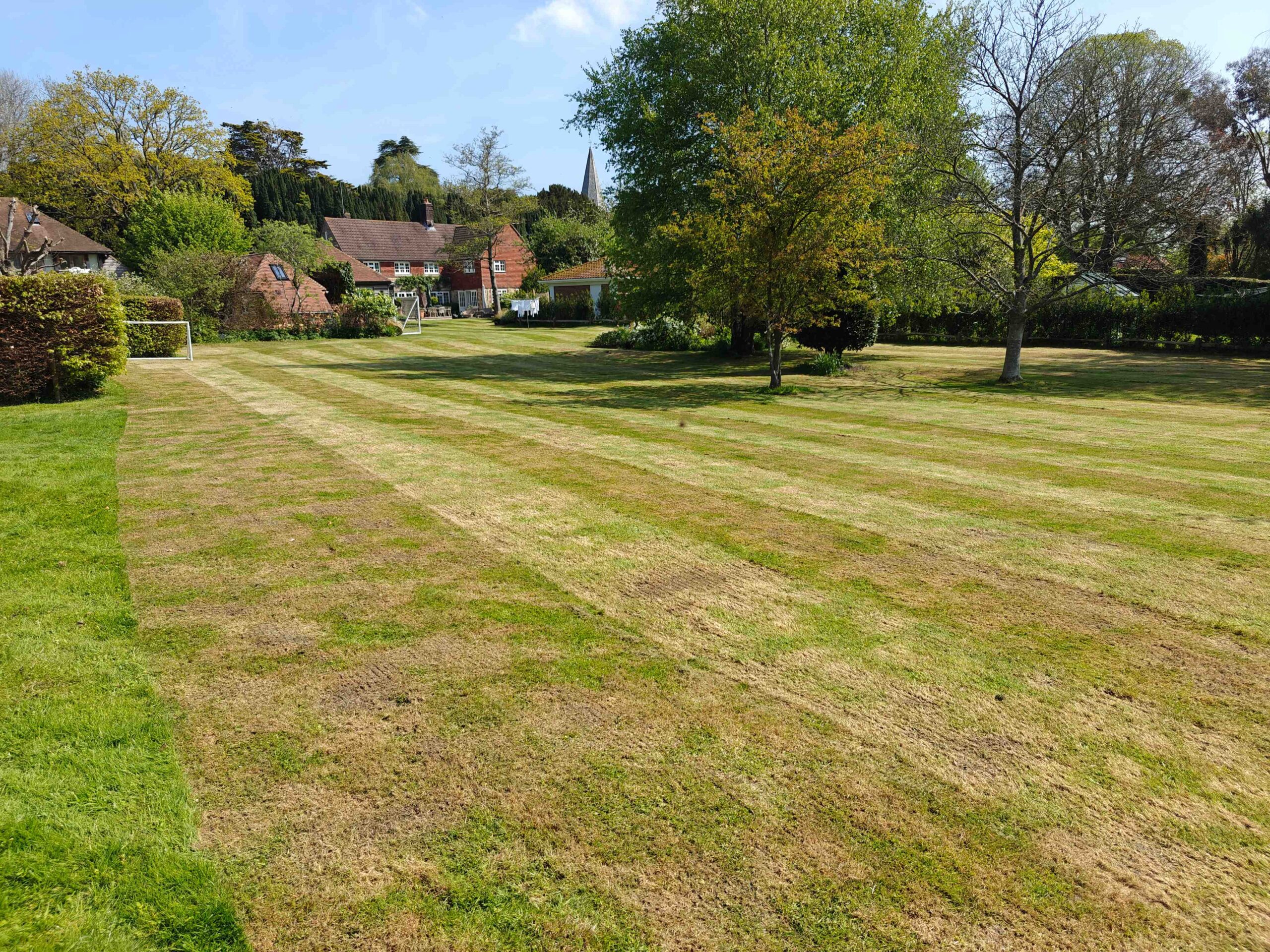
Improving the surface over time through top-dressing, which fills hollows and gradually levels the lawn profile, is a background investment that pays dividends in the quality of every subsequent mow. Combined with regular aeration to prevent compaction and scarification to control thatch, it produces the kind of firm, level surface that makes consistent mowing genuinely straightforward.
These are not quick fixes. A lawn surface improved through top-dressing and regular renovation takes two to three seasons to change meaningfully. But the improvement in both lawn health and the quality of the mowed finish is substantial and lasting.
Why Professional Lawn Care Supports a Better Mowed Finish
The quality of a mowed lawn is inseparable from the underlying health and structure of the turf. A well-fed lawn with adequate root depth, good density, and a firm, level surface simply mows better than a thin, compacted, or uneven one. Professional lawn care produces the conditions that make a good finish achievable.
At Shrekfeet, our treatment programmes cover seasonal feeding that maintains grass density and colour, aeration that relieves compaction and improves surface firmness, scarification that controls thatch and improves mower contact with the grass surface, and overseeding that fills thin areas and produces a consistent sward. Our City and Guilds trained technicians assess the specific condition of your lawn and design a programme that addresses what is actually limiting its quality. We are BASIS Lawn Assured accredited and cover Hampshire, Surrey, West Sussex, and Berkshire.
If your lawn is consistently difficult to mow to a good finish, or if the mowed result never quite looks as good as you would like, an assessment of the underlying surface quality and turf health is a more productive starting point than changing the mower.
Frequently Asked Questions
In most cases this is the normal and desirable result of a roller-equipped mower bending adjacent strips of grass in opposite directions. Light reflects differently from grass bent towards you compared to grass bent away, creating the alternating stripe effect. If the stripes look uneven in height rather than simply different in shade, an unlevel mower deck or missed strips between passes may be the cause.
Use a mower with a rear roller, mow in straight parallel passes using a fixed reference point ahead of you rather than looking down, mow when the grass is dry, and keep the cutting height at four to five centimetres rather than cutting short. Alternating the mowing direction between sessions and ensuring even overlap between passes both improve the consistency and definition of the result.
Pale or bleached-looking streaks shortly after mowing are most commonly caused by a blunt mower blade. A blunt blade tears rather than cuts the grass cleanly, and the torn tips dry out and turn pale within a day or two. Check the cut tips of the grass blades: ragged, frayed tips confirm a blade sharpness problem. Sharpening or replacing the blade resolves this immediately.
You need a mower with a rear roller. Many cylinder mowers and a good number of roller-equipped rotary mowers produce stripes as a standard feature. Hover mowers do not stripe. Rotary mowers without rear rollers produce limited or no stripe effect. Aftermarket striping roller attachments are available for some mower models if you want to improve the striping effect from a mower you already own.
Patchy unevenness after mowing typically indicates either scalping on raised areas of an uneven surface, an unlevel mower deck cutting to different heights across its width, or significant thatch causing inconsistent contact between the mower and the grass surface. Raising the cutting height reduces scalping on uneven ground. Checking and levelling the mower deck addresses height inconsistency. Scarification controls thatch and improves surface contact over the following season.
In summer, mowing every seven to ten days in normal conditions, or every five to seven days during periods of active growth, maintains the lawn at a consistent height that mows well and stripes cleanly. Allowing the lawn to grow long between cuts and then cutting back hard in a single pass produces a poorer finish and greater stress to the grass than frequent cutting at a consistent height. During dry spells when growth slows, extend the interval and raise the cutting height rather than cutting to the same height on a fixed schedule.
Want a lawn that mows to a better finish?
Our technicians cover Hampshire, Surrey, West Sussex, and Berkshire. We will assess the underlying surface quality and turf health of your lawn and design a programme that addresses what is actually limiting the result.







 Made with love by: