
 Established 2016
You look out at the lawn and something is not right. What was green a few weeks ago is now streaked with yellow, or there are patches of straw-coloured grass sitting in an otherwise reasonable lawn, or the whole thing has taken on a pale, washed-out appearance that it did not have in spring.
🎧 Prefer to listen? Get the full diagnosis guide in your ears
Why Is My Grass Turning Yellow? (And How to Fix It)
Yellow grass is one of the most common concerns homeowners raise with us through the summer months, and it is understandable. A yellow lawn looks unhealthy and often prompts the assumption that something has gone seriously wrong. In most cases, the reality is more straightforward: yellow grass has a cause, that cause is usually identifiable, and most of the common causes are fixable.
The important thing is to identify which cause is at play before reaching for a product or taking remedial action. Treating drought dormancy the same way you would treat a nutrient deficiency, or assuming a fungal disease is simply a dry patch, leads to wasted effort and sometimes worsens the original problem. This guide covers the most common reasons UK lawns turn yellow in summer, how to tell them apart, and what to do about each one.
Drought Dormancy: The Most Common Cause in Summer
The most frequent reason established UK lawns go yellow in summer is drought dormancy, and it is worth covering this one first because it is also the cause most likely to alarm homeowners unnecessarily.
Grass is a remarkably resilient plant. When water becomes scarce, most UK grass species, including the fescue, ryegrass, and bent mixes that make up the majority of domestic lawns across Hampshire, Surrey, West Sussex, and Berkshire, respond by entering a state of dormancy. Leaf growth stops. Colour fades from green to yellow and then to a straw-brown. The lawn looks, to all appearances, dead.
It is not dead. The growing points of the grass plant, the crown tissue just above soil level, remain alive even when the visible foliage has completely dried out. When rainfall returns or temperatures drop in late summer, the crown tissue triggers new growth and the lawn greens up, often surprisingly quickly.
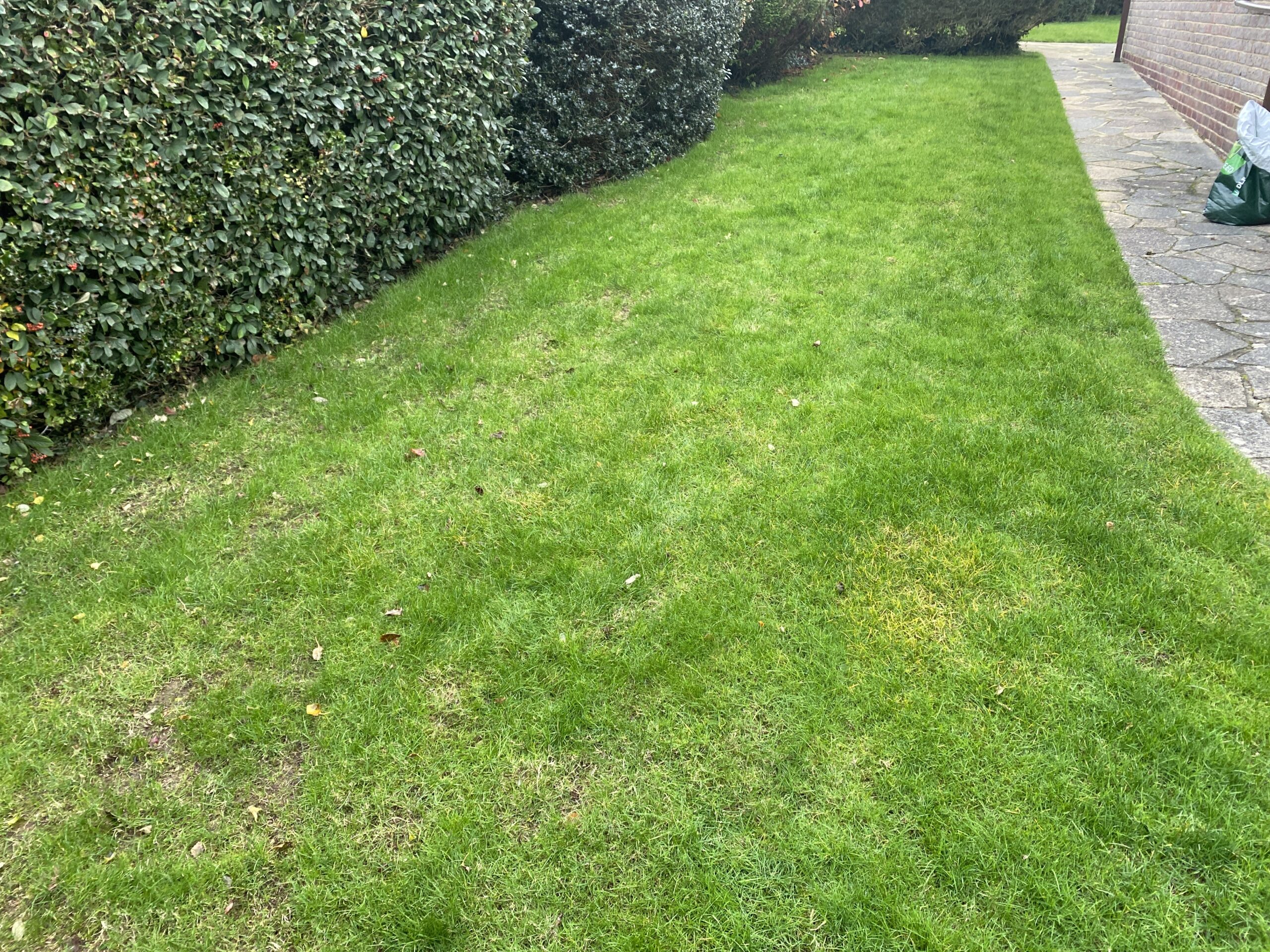
The distinguishing features of drought dormancy are consistent yellowing or browning across the whole lawn rather than distinct patches, a firm, dry feel at soil level with no soft or rotten tissue, and a clear correlation with a recent dry spell. If the last three weeks have been dry and sunny and the whole lawn has faded, dormancy is almost certainly the explanation.
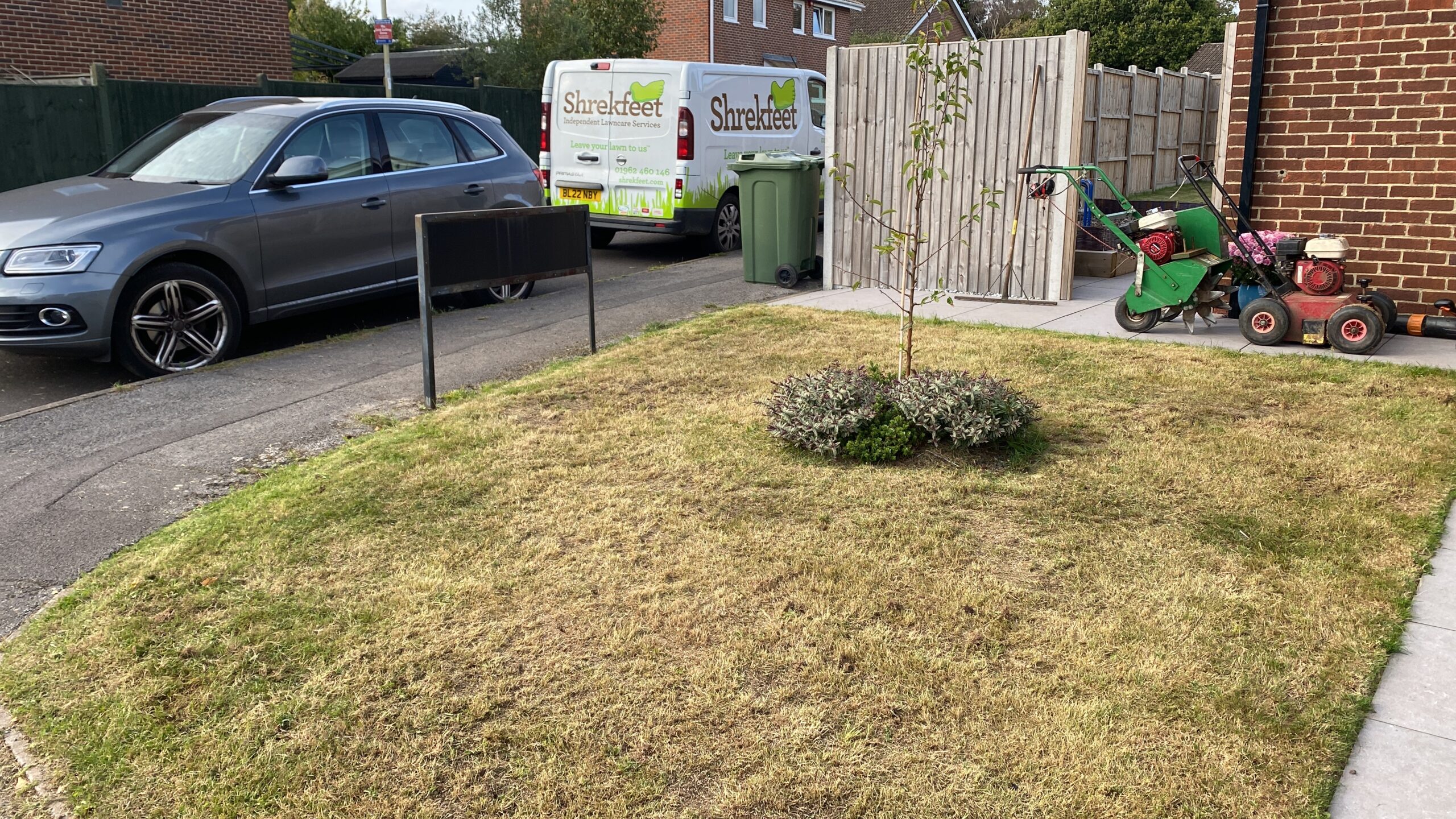
What to do: in most cases, nothing. Leave the lawn alone, avoid heavy foot traffic, and allow natural rainfall to trigger recovery. If the dry spell extends beyond three to four weeks with no rain in the forecast, watering deeply once or twice a week can reduce the severity of dormancy and speed recovery, but light daily watering does more harm than good.
Nitrogen Deficiency
A lawn that has not been fed with an appropriate nitrogen-containing fertiliser will gradually lose its colour as the growing season progresses. Nitrogen is the primary nutrient responsible for green leaf growth. When the grass has access to sufficient nitrogen, it produces the chlorophyll that gives healthy turf its characteristic deep green colour. When nitrogen levels drop, colour fades to a pale or yellowish green.
Nitrogen deficiency yellowing tends to be uniform across the lawn rather than patchy. The whole lawn takes on a pale, washed-out look. It is most common in spring on lawns that did not receive a spring fertiliser treatment, and in summer on lawns where the spring feed has been exhausted and no follow-up feed has been applied.
This is distinct from drought dormancy in a couple of important ways. A nitrogen-deficient lawn is not dormant; the grass is still growing, just slowly and with poor colour. It is also more likely to show this uniform pallor than the more complete dieback associated with serious drought stress.
What to do: apply an appropriate summer fertiliser. In summer, a balanced product with moderate nitrogen and good potassium content is preferable to a high-nitrogen spring feed, which can scorch during hot, dry conditions. Do not apply fertiliser to a lawn that is severely drought-stressed and showing no signs of active growth. Wait for conditions to improve or for a period of rain before feeding.
Lawn Scorching From Fertiliser
Somewhat ironically, applying fertiliser incorrectly can itself cause the yellowing you were trying to fix. Fertiliser scorch occurs when a granular or liquid feed is applied in excessive concentration, applied unevenly, or applied to dry grass in hot weather without adequate moisture to help it disperse into the soil.
Scorch produces a distinctive pattern: yellow or brown streaks corresponding to the direction of application, or irregular bright yellow patches where product was applied unevenly or where granules were dropped in clumps. The damage is typically localised rather than uniform across the whole lawn.
The risk of scorch from granular fertiliser depends almost entirely on the product being used. Non-coated synthetic granular fertilisers with a high salt index are the primary culprit: the concentrated salts draw moisture out of the grass cells rather than nourishing them, particularly when applied in dry conditions without adequate moisture to disperse them into the soil. Plant-based or organic granular fertilisers with a low salt index carry essentially no scorch risk because they do not create the osmotic stress that synthetic salt-based products can. The specific risk with any granular product in warm weather is dew: if granules stick to grass leaves overnight and the following morning is hot, the localised concentration on the leaf surface can cause scorching. Where morning dew is a concern, applying a dew dispersant beforehand removes this risk entirely.
What to do: water the affected area thoroughly to dilute and disperse the concentrated product. The lawn will typically recover within two to four weeks as the damaged tissue grows out, provided the area is kept moist. Avoid applying non-coated, high-salt synthetic granular fertilisers to dry grass in hot weather without moisture to disperse them. If using any granular product when morning dew is likely, apply a dew dispersant beforehand to prevent granules sticking to leaf surfaces.
Fungal Disease: Red Thread and Other Summer Infections
Not all yellow patches in a summer lawn are caused by drought or nutrient issues. Fungal diseases are common in UK lawns through the warmer months and produce distinctive patterns that are easily distinguished from drought damage once you know what to look for.
Red Thread
Red thread is the most common summer turf disease in UK gardens. It is caused by the fungus Laetisaria fuciformis and is most active during warm, humid conditions, particularly after periods of overcast weather with overnight dew.
The distinguishing feature is the appearance of small, pinkish-red needle-like threads extending from the tips of grass blades, visible on close inspection. Affected patches are typically roughly circular or irregular in shape, ranging from a few centimetres to thirty centimetres across. The patches take on a bleached, pinkish-tan colour rather than the straw-yellow of drought dormancy.
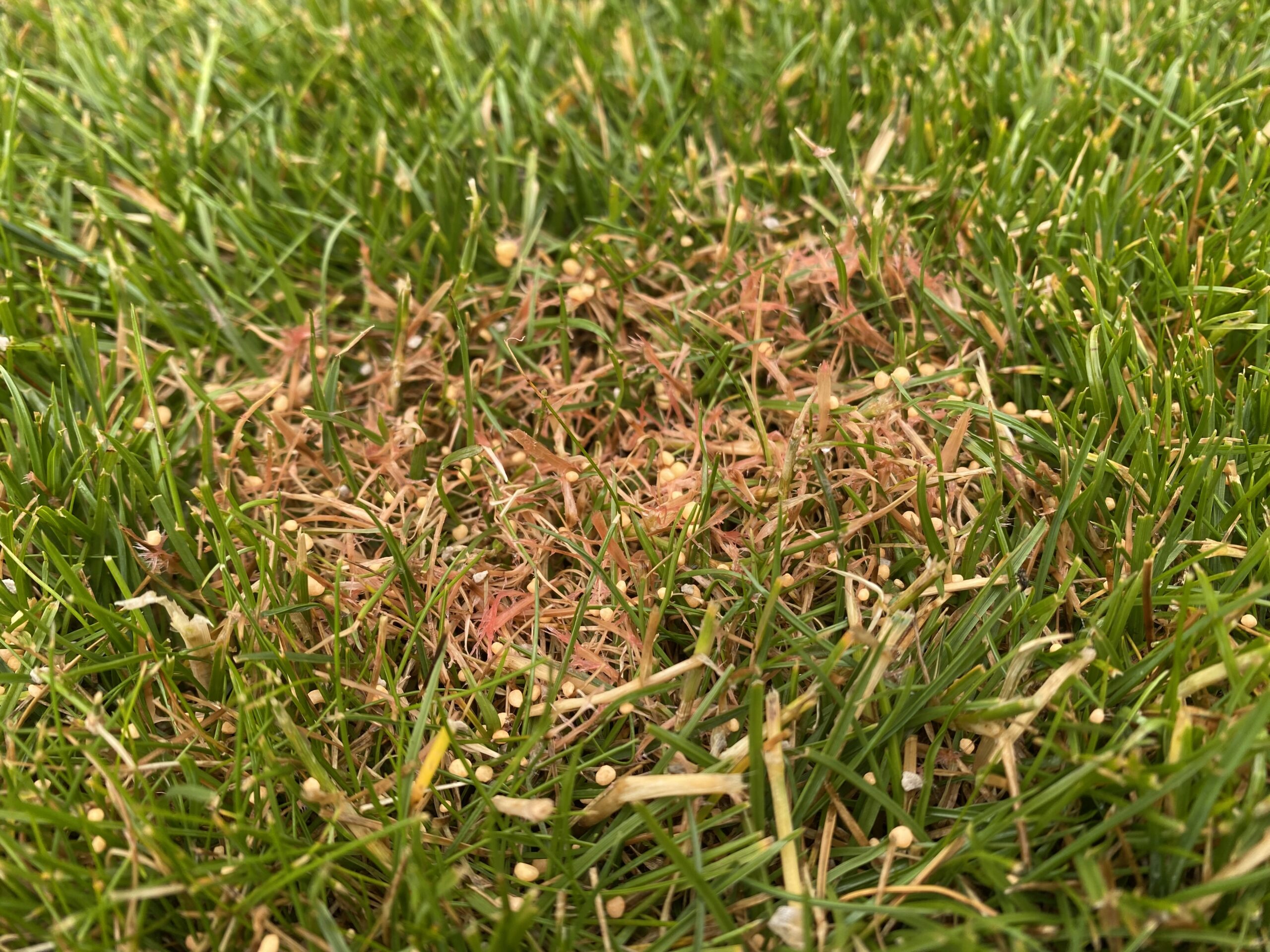
Red thread is strongly associated with nitrogen-deficient turf. A well-fed lawn is considerably more resistant to infection because the grass is producing new growth quickly enough to outpace the fungal activity. Conversely, a lawn that has not been fed through the season is significantly more susceptible.
What to do: apply a nitrogen-containing fertiliser to support recovery and reduce susceptibility. Red thread rarely kills grass permanently; the crowns remain alive and the lawn grows through the damage in most cases. In severe or persistent outbreaks, professional treatment with an appropriate fungicide produces faster and more complete recovery.
Fusarium Patch
Fusarium, caused by Microdochium nivale, is less common in high summer but can appear in late summer as temperatures begin to moderate and overnight temperatures drop. It presents as small, roughly circular patches of yellowed or dying grass, often with a characteristic salmon-pink or orange colouration at the margins of active patches.
Fusarium is more damaging than red thread and can kill grass completely in the affected areas if left untreated. It is more prevalent on fine ornamental turf than on coarser utility lawn mixes, and is favoured by cool, damp conditions and high nitrogen fertiliser applications in late summer or autumn.
What to do: professional treatment is recommended for confirmed fusarium outbreaks. Avoid applying high-nitrogen feeds in late summer or autumn as this increases susceptibility. Maintain good air circulation by keeping hedges and boundaries well trimmed.
Pet Urine Damage
Dog urine causes distinctive circular yellow or brown patches, typically with a darker green ring around the perimeter. The nitrogen concentration in urine scorches the grass at the centre of the patch while the diluted outer edges receive a mild fertilising effect, producing the characteristic bullseye pattern.
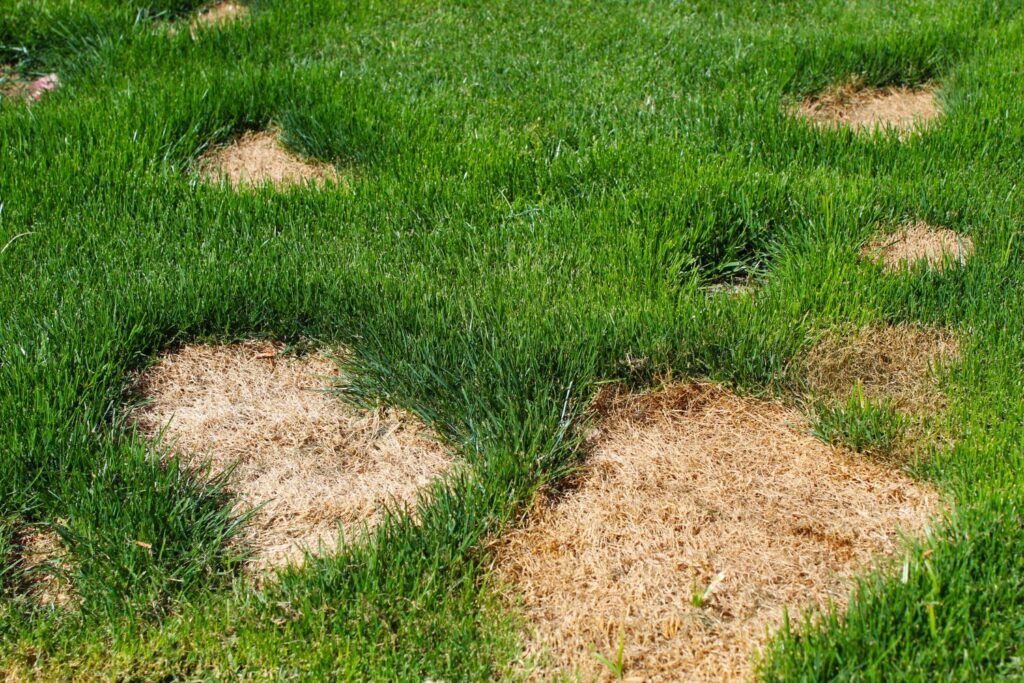
These patches are easy to identify once you know the pattern. They appear in the same areas repeatedly if the dog has consistent habits, and they tend to be more numerous and more severe on lawns used heavily by female dogs, whose habit of squatting means urine is deposited in a concentrated area rather than spread over a wider patch as with male dogs.
What to do: water affected areas immediately after the dog has been on the lawn to dilute the urine before it causes damage. Overseeding damaged patches after recovery is the most reliable way to restore a consistent sward. There is no treatment that reverses existing urine damage; the grass in the central patch has died and needs to be replaced.
Compaction and Waterlogging in Specific Areas
If particular areas of the lawn consistently yellow or thin out while the rest of the lawn is fine, localised soil problems are often the cause. Heavily compacted areas, where foot traffic has pressed soil particles tightly together, restrict both drainage and root development. In summer, compacted patches dry out faster than the rest of the lawn because the restricted soil cannot hold moisture effectively, and the shallow roots in those areas have less access to subsoil water.
Similarly, areas directly above buried rubble, tree roots, or hard landscape features are often significantly shallower in soil depth than the rest of the lawn. These areas go into stress, and then dormancy, faster and more severely during dry spells because there is simply less soil to hold moisture.
What to do: hollow-tine aeration in autumn addresses compaction and significantly improves the soil structure and water retention of affected areas over time. For very shallow areas above hard surfaces or rubble, top-dressing with a sandy loam mixed with compost gradually builds soil depth and improves conditions.
Cutting Too Short
Scalping, cutting the grass shorter than it should be, or setting the mower too low for the conditions, produces yellowing and browning of the grass that is sometimes mistaken for disease or nutrient deficiency.
When grass is cut too short, the growing point is exposed or damaged, reducing the plant’s ability to regrow. The exposed soil surface heats up rapidly in warm weather, further stressing the root zone. The reduced leaf area means less photosynthesis, less stored resource, and grass that cannot cope with any additional pressure from heat or drought.
Look for yellowing that follows the lines of mowing, or a lawn that goes from fine to yellow very quickly after cutting. Lowering the wheels of the mower too far during a dry spell, when the lawn surface is uneven and the mower scalps the raised areas, is a common trigger.
What to do: raise the cutting height immediately. For a lawn already showing signs of stress, rest it from mowing until conditions improve and new growth is established. As a general rule through June, July, and August, cutting no lower than four to five centimetres reduces stress significantly and helps the lawn hold its colour through dry periods.
How to Tell the Causes Apart
The pattern and distribution of yellowing is the most useful diagnostic tool:
Uniform pale yellowing across the whole lawn with no distinct patches, correlating with dry weather or the absence of recent feeding: drought dormancy or nitrogen deficiency.
Distinct circular or irregular patches with pinkish-red threads visible on the grass blades: red thread fungal disease.
Small circular patches with salmon-pink or orange margins, appearing in late summer: potential fusarium, professional assessment recommended.
Circular patches with a darker green outer ring: pet urine damage.
Streaks or irregular bright yellow areas corresponding to application pattern after fertilising: fertiliser scorch.
Consistent patches in the same locations each summer with no obvious surface cause: likely compaction or shallow soil depth beneath.
Yellowing following recent mowing with a pattern matching the mower lines: cutting too short or scalping.
Why Professional Diagnosis Makes a Difference
Getting the diagnosis right before taking action saves time, money, and further damage to the lawn. Applying a nitrogen feed to a lawn with fertiliser scorch worsens the problem. Applying a fungicide to a lawn suffering from drought dormancy achieves nothing. Aerating compaction is the right response to restricted patches but does nothing for a nitrogen-deficient lawn.
At Shrekfeet, our technicians are trained to identify the specific causes of lawn deterioration rather than applying generic treatments. We assess colour patterns, soil condition, grass density, recent weather, and treatment history before recommending any course of action. Our BASIS Lawn Assured accreditation means every recommendation we make is grounded in professional standards and accurate diagnosis.
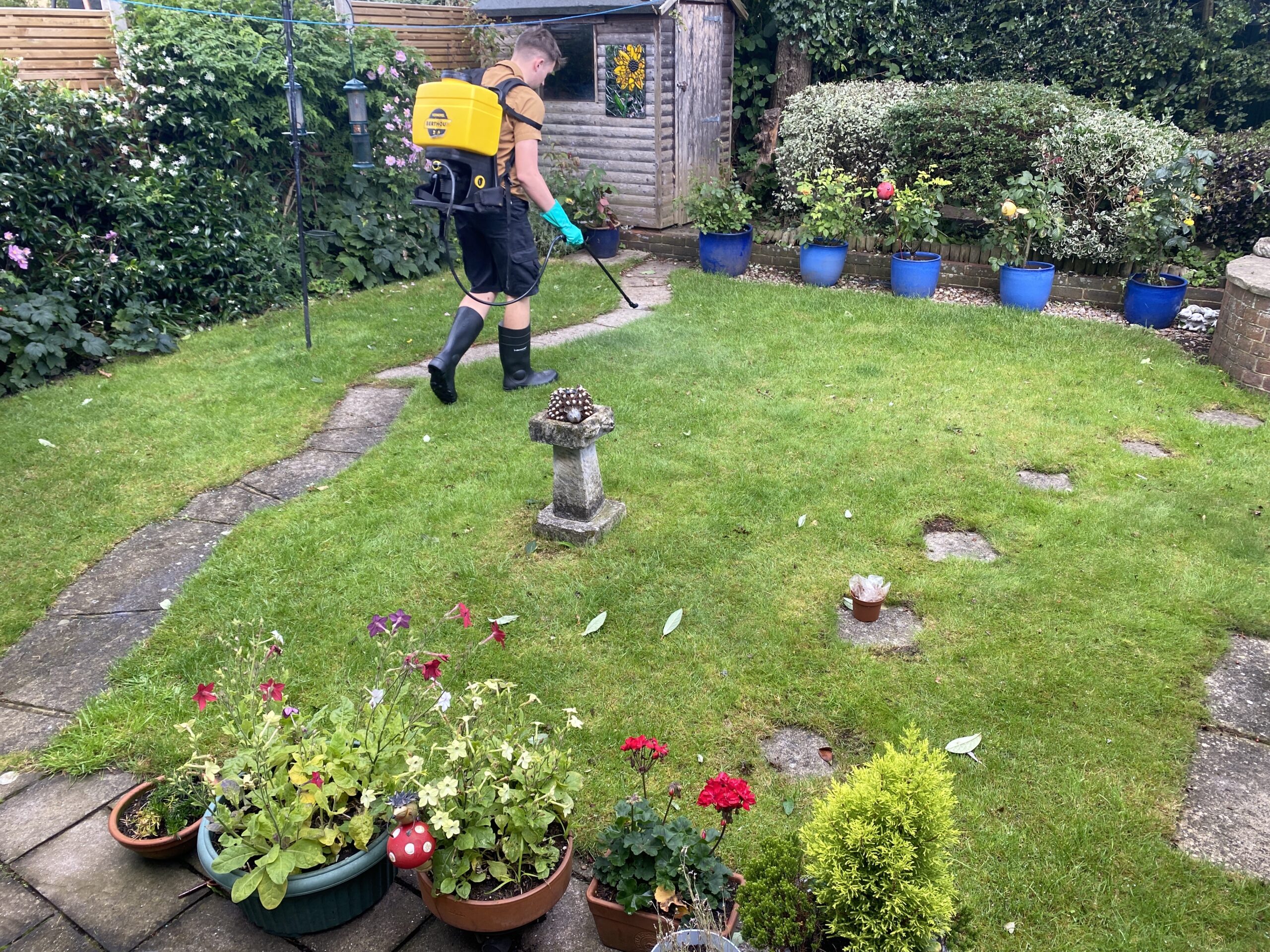
We cover Hampshire, Surrey, West Sussex, and Berkshire, and our City and Guilds qualified technicians have seen every variation of summer lawn problem across the range of soils and conditions in our service area. If your lawn is turning yellow and you are not sure why, a professional assessment will give you a clear answer and a clear path forward.
Frequently Asked Questions
Almost certainly not. An established UK lawn that goes yellow during a dry spell is most likely in dormancy, a natural protective response where the grass reduces activity to conserve water. The growing points remain alive at soil level. The lawn will recover when moisture returns, usually without any intervention. Check the base of the grass: if the crowns are still firm rather than soft and rotten, the lawn is dormant not dead.
Patchy yellowing rather than uniform pallor points to a localised cause. The most common culprits are pet urine damage, fungal disease such as red thread, compaction in specific areas, or scalping from mowing too low on uneven ground. The pattern and distribution of the patches, plus a close inspection of the grass blades in the affected areas, usually makes the cause clear.
Yes, in most cases. Drought-dormant grass recovers naturally when rainfall returns. Nitrogen-deficient grass responds to an appropriate feed within ten to fourteen days. Red thread grows out with feeding and, in persistent cases, fungicide treatment. Fertiliser scorch grows out within two to four weeks with adequate watering. The only causes that typically require physical repair are severe pet urine damage, where the grass in the central patch has died, and severely scalped areas.
It depends on the cause. If the yellowing is drought dormancy, deep watering once or twice a week in prolonged dry spells can help, but light daily watering does more harm than good. If the cause is fertiliser scorch, watering thoroughly to dilute the product is the right response. If the cause is fungal disease, be cautious about overwatering as excess moisture encourages further fungal activity.
The most likely cause is cutting too short. If the mower is set low and the grass is already stressed by heat or dryness, mowing removes too much of the leaf blade and exposes the crown to heat and desiccation. Raise the cutting height, particularly through summer, and avoid mowing when the lawn is already showing signs of drought stress. Blunt mower blades can also contribute by tearing rather than cutting the grass cleanly, leaving ragged tips that yellow and die back.
It can be, but disease is only one of several possible causes and not the most common one in summer. If the yellowing is uniform and correlates with dry weather or lack of feeding, disease is unlikely. If you can see pinkish threads on the grass blades, or circular patches with coloured margins, disease is more probable and worth investigating properly. Professional diagnosis is the most reliable way to confirm whether disease is involved.
Not sure why your lawn is turning yellow?
Our technicians cover Hampshire, Surrey, West Sussex, and Berkshire. We will assess the specific condition of your lawn, identify the cause, and put together a programme that addresses it properly.







 Made with love by: